
Labyrinthulales
Labyrinthulales
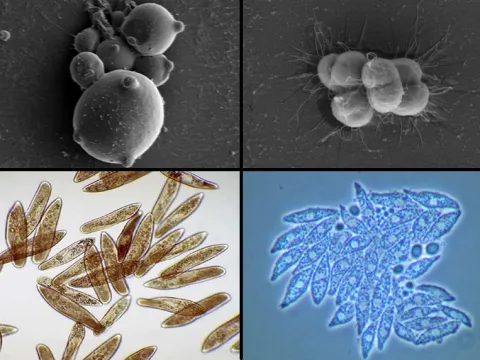
Labyrinthulales are a group of unicellular eukaryotic microorganisms belonging to the class Labyrinthulomycetes. Previously thought to be fungi, they are now classified as specialized protists often found in marine and estuarine environments.
What the section contains
Labyrinthulales
The pathogen functions as a network of motile cells connected by ectoplasmic filaments. These so-called labyrinthulae are capable of active movement across surfaces and can penetrate plant tissues to absorb nutrients through osmosis.
Biologically, these organisms act as osmotrophs, secreting specific enzymes to break down the cell walls of seagrasses extracellularly. Their life cycle includes both asexual reproduction through the formation of zoospores and colonial cell division.
In an agricultural and ecological context, they are known as host-specific pathogens of seagrasses, particularly affecting genera such as Zostera and Thalassia. They do not pose a risk to terrestrial crops, focusing their activity on marine ecosystems.
The study of these pathogens is vital for coastal management, as massive outbreaks can lead to the widespread degradation of seagrass meadows, which are critical habitats for marine life and commercially important fish species.
The primary symptom of infection is the emergence of distinct black or dark brown lesions on seagrass leaves. These spots expand rapidly, causing the affected areas to lose pigmentation and eventually disintegrate.
Early stages of the disease may show yellow or pale margins around the spots, indicating the intense breakdown of chlorophyll within the plant tissues. Consequently, the plant loses its photosynthetic efficiency, leading to rapid tissue death.
In severe cases, the infection destroys the entire shoot system and compromises the rhizomes, leading to total collapse of the seagrass meadow. This leaves the seabed exposed and vulnerable to erosion.
Microscopic analysis of the infected tissue reveals the presence of characteristic branching cell networks of the pathogen. These structures penetrate the intercellular spaces, effectively draining the plant's resources.
Leaf shedding is another common indicator of infection, which significantly thins out the canopy of the seagrass bed. Affected meadows often appear "scorched" or sparse, reflecting the severe systemic impact of the pathogen.
The development of Labyrinthulales is highly dependent on water temperature: warmer-than-average conditions often trigger disease outbreaks, as the stress on plants makes them more susceptible to colonization by the pathogen.
Salinity is a critical factor for the pathogen's lifecycle. Fluctuations in salinity, whether caused by excessive freshwater runoff or high evaporation rates, can create environmental niches that favor the proliferation of Labyrinthula colonies.
High host density facilitates the rapid transmission of the pathogen. In dense meadows, the parasite moves easily between individuals, allowing the infection to spread across vast areas in a short period.
Water quality, including the level of eutrophication, plays a significant role. Elevated nutrient levels in the water column can promote the growth of microorganisms and potentially trigger or exacerbate wasting disease events.
Mechanical damage to leaves, often caused by storms, wave action, or marine grazing animals, serves as a primary entry point for the pathogen, significantly accelerating the infection process in healthy plant tissues.
The harm caused by Labyrinthulales lies in the destruction of primary producers in marine ecosystems. The loss of seagrass leads to the disappearance of nurseries and feeding grounds for many commercial fish, causing direct economic damage to fisheries.
The destruction of rhizomes leads to seafloor erosion, increasing water turbidity and negatively affecting other photosynthesizing organisms that require clear water to thrive.
From an economic perspective, the degradation of seagrass meadows reduces the recreational and coastal protection value of marine areas. Restoring these habitats requires significant time and large financial investments.
The pathogen is capable of causing long-term epidemics that prevent natural recovery for several years. This can result in a permanent shift in the floral composition of the affected coastal zone.
Globally, the decline of seagrass meadows reduces the ocean's carbon sequestration capacity, making these pathogens a contributing factor to broader climate-related shifts in coastal stability.
Chemical control measures are generally not feasible in marine environments due to the high risk of environmental toxicity to other marine organisms. Management primarily focuses on monitoring and mitigation.
A key preventive measure is maintaining good water quality by limiting agricultural runoff and industrial wastewater discharge. A balanced hydrochemical state is the most effective natural defense against outbreaks.
Research into the selection and outplanting of pathogen-resistant seagrass genotypes is a promising strategy for restoring damaged ecosystems. Genetic variation among seagrasses often determines their resistance levels.
Reducing anthropogenic impact, such as regulating boat traffic and anchoring in sensitive areas, minimizes mechanical trauma to the plants and consequently reduces the likelihood of infection outbreaks.
- Continuous biological monitoring of coastal zones.
- Regulation of pollutants and nutrient runoff into marine waters.
- Utilization of genetically resistant seagrass strains.
- Creation of marine protected areas with restricted human activity.
- Scientific research on seagrass resistance mechanisms.