
Hypogymnia
Hypogymnia
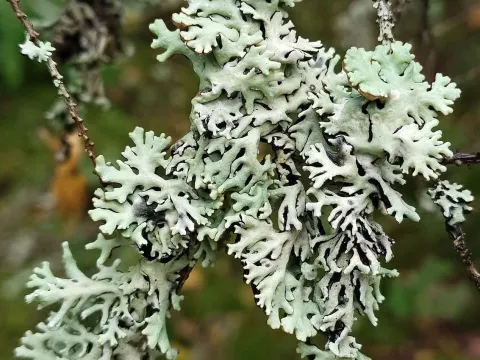
Hypogymnia appears as foliose thalli, which are tightly attached to tree bark. These thalli have greyish, greenish-grey, or brownish shades, often with characteristic inflated lobes.
What the section contains
Hypogymnia
Visually, colonies look like rosettes that gradually expand, covering significant parts of trunks and main branches over time.
The edges of the lobes are often elevated, and the surface can be smooth or slightly wrinkled, which is a distinctive feature of this lichen genus.
Upon close inspection, one can observe the lack of rhizines, which makes the thallus relatively easy to detach from the bark through physical cleaning.
In early stages, the lichen occupies small areas, but given favorable conditions, it quickly colonizes younger branches, forming a protective layer.
Hypogymnia is a genus of lichen, which is a symbiotic organism consisting of a fungus (mycobiont) and an alga (phycobiont). In agronomy, this is not considered a true parasitic pathogen.
The fungus provides structural support on the bark and mineral nutrients, while the alga performs photosynthesis, supplying the organism with organic food.
It belongs to the Parmeliaceae family. Biologically, Hypogymnia is an epiphyte that uses the tree exclusively as a substrate for attachment.
Reproduction occurs vegetatively through fragments of the thallus, which are easily transported by wind or raindrops to neighboring plants.
Despite the lack of direct parasitism, the presence of lichen indicates potential underlying problems with tree metabolism or an unfavorable microclimate.
The development of Hypogymnia is encouraged by high air humidity and poor canopy aeration caused by overcrowded plantings.
Colonies most often settle on weakened, old, or sick trees, where the bark has deep cracks and irregularities that retain moisture effectively.
Optimal conditions include moderately low temperatures and sufficient light required for the photosynthetic component of the lichen.
Lack of regular sanitary maintenance, such as pruning and trunk cleaning, contributes to the rapid colonization of the garden by this epiphyte.
Proximity to forested areas also acts as a risk factor, as spores or thallus fragments can be blown onto fruit trees from surrounding trees.
Hypogymnia does not cause direct damage to plant tissues as it does not feed on tree sap, yet its presence significantly compromises tree health.
Continuous coverage of the bark by lichen hinders normal gas exchange, leading to the gradual suppression of the bark's vital functions.
A damp microenvironment often forms under the lichen layer, providing an ideal breeding ground for pests like scale insects or mites.
Lichen layers retain moisture, which can lead to premature bark cracking during winter due to freeze-thaw cycles.
The presence of lichen serves as an indicator of reduced overall productivity and vitality, necessitating intervention by the grower.
The primary control measure is the mechanical cleaning of the bark using specialized brushes or scrapers during the plant's dormant period.
After removing the lichen, it is recommended to apply a lime wash containing copper sulfate to disinfect the bark surface.
It is essential to conduct regular sanitary and structural pruning to improve air circulation and light penetration throughout the crown.
- Thinning out dense crowns to reduce ambient humidity.
- Applying fungicide treatments during spring or autumn maintenance.
- Supporting overall tree health through balanced fertilization and proper irrigation.
In cases of severe infestation, the use of professional copper-based chemical treatments is recommended in accordance with label instructions.