
Hypomyces lateritius
Hypomyces lateritius
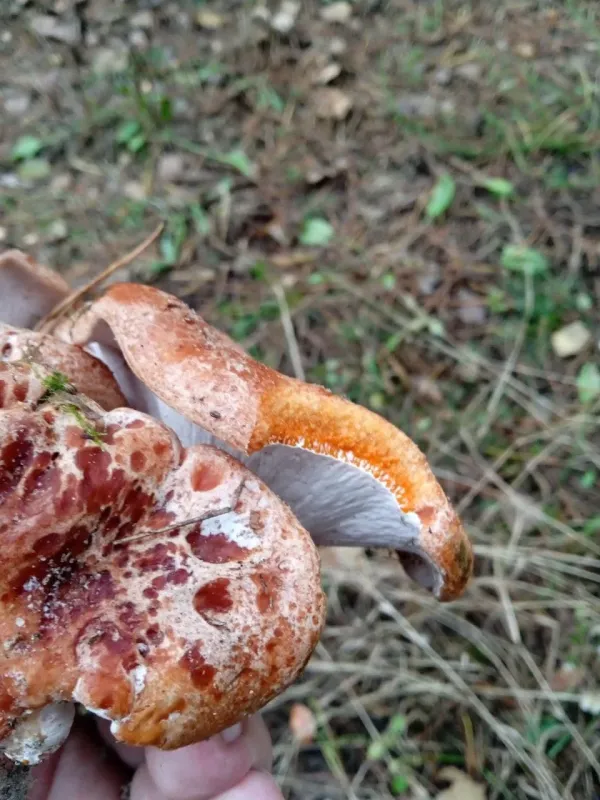
Description
Symptoms
The primary external sign of infection is severe deformation of the mushroom's fruit body. Affected saffron milk caps or other Lactarius species lose their typical shape, becoming dense, rigid, and acquiring a characteristic brick-red or yellowish-orange color.
On the surface of the host's gills, there is a total disappearance of the normal spore-bearing layer. Instead of gills, a continuous, often felt-like coating forms, which eventually densifies and takes on a granular texture.
As the disease progresses, the fruit body becomes hardened, or "petrified." It is rarely consumed by insects or larvae, as the tissues become too tough and lack the necessary nutritional value for them.
A characteristic symptom is the loss of the typical aroma inherent to the host species. The smell becomes musty, and the taste turns bitter, rendering the mushroom unfit for culinary use.
- Loss of typical cap and stem shape.
- Color change to a brick-red hue.
- Overgrowth of the gills with fungal tissue.
- Hard, cork-like texture of the fruit body.
Pathogen
The causal agent of the disease is the ascomycete fungus Hypomyces lateritius. This microorganism is a highly specialized parasite that targets higher fungi, particularly within the Russulaceae family.
The biology of the pathogen involves the development of mycelium directly within the tissues of the host mushroom. During its lifecycle, the parasite significantly alters the metabolism of the host, effectively halting its normal development.
The lifecycle includes the production of conidia, which are dispersed by wind, rain droplets, or insects to healthy specimens. Spores germinate upon contact with a suitable surface, initiating the colonization of host tissues.
The fungus exhibits high host specificity, most frequently attacking various species of milk caps (Lactarius), such as the saffron milk cap, making it an essential subject in forest mycology.
Morphologically, the parasite manifests as a dense fungal mass that replaces the normal structures of the gills and hymenium. This process transforms the edible mushroom into a deformed, inedible substance.
Conditions for development
The development of Hypomyces lateritius is directly dependent on environmental humidity. The most active spread of the parasite occurs during periods of prolonged rainfall and high air humidity in forested areas.
Temperature plays a secondary role, although moderately warm summers facilitate the faster maturation of the pathogen's spores. Optimal conditions for infection often coincide with the peak fruiting periods of host fungi.
Mycelial density in the soil also influences the level of infection. In areas where the mycelium of host mushrooms is distributed densely, outbreaks of the fungal parasite are more intense, affecting a significant portion of the population.
Poor ventilation in dense forest stands creates a greenhouse effect that favors spore germination. In well-ventilated forest areas, the infection rate of fruit bodies is typically significantly lower.
The presence of insect vectors accelerates the spread of the infection between distant mycelial colonies. Interactions between mycophilous insects and parasite spores are key factors in its geographic dispersal.
Why it matters
The main damage caused by this parasite is the complete loss of the nutritional and economic value of wild mushrooms. Mushroom collectors frequently encounter groups of milk caps that are entirely infected and unsuitable for harvest.
Economic losses are significant for those involved in the commercial collection and processing of wild mushrooms. The disease reduces the overall yield during the season, turning edible mushrooms into waste.
For forest ecosystems, Hypomyces lateritius acts as a natural regulator of Lactarius populations. It limits the uncontrolled reproduction of certain species, thereby maintaining a biological balance within the fungal community.
Infection by this parasite results in the inability of the host to disperse spores. This means the host population in a specific area may decrease in subsequent years due to the lack of spore propagation.
In some cases, the underground mycelium is also affected, as the parasite partially utilizes the host's resources to build its own biomass, ultimately weakening the perennial mycelium in the forest floor.
Protection
Currently, there are no effective chemical control methods for Hypomyces in natural forest environments. Forests are uncontrollable systems where the application of fungicides is prohibited and impractical.
The primary preventive measure is sanitary control during mushroom collection. It is important to remove infected specimens from the forest to prevent the further dispersal of spores into the atmosphere and soil.
Do not leave infected fruit bodies on the ground, as this creates a source of infection. It is recommended to dispose of them or bury them deep to limit the release of spores onto the surface.
Rational use of forest resources and maintaining forest cleanliness help reduce the intensity of parasite development. The absence of excessive plant debris accumulation contributes to better forest floor aeration.
Monitoring mushroom-rich areas allows collectors to avoid zones with high infection rates, thereby preserving the quality of the harvest. Knowledge of the disease's external signs is the best tool for preventing infected mushrooms from being collected.
Discussion
No discussions yet — be the first.