
Hypomyces lactifluorum
Hypomyces lactifluorum
Description
Symptoms
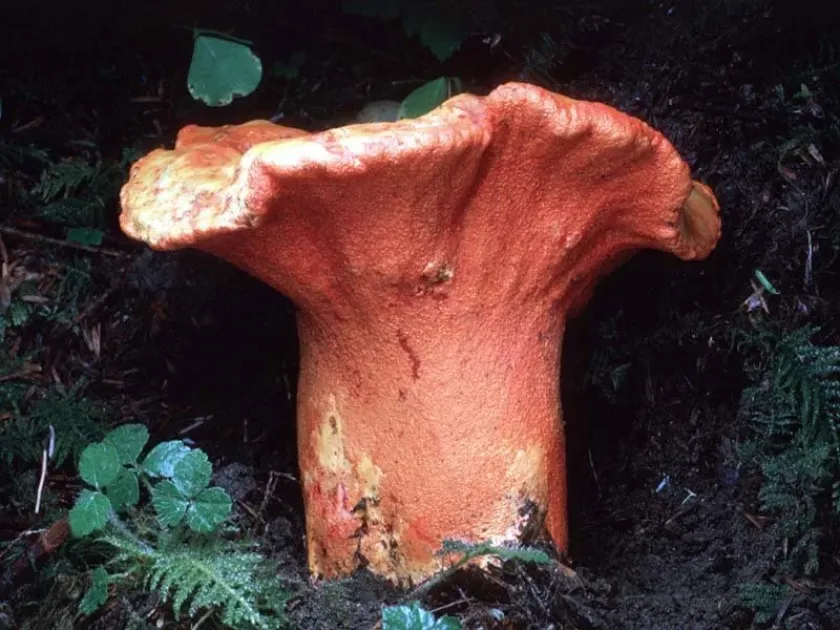
The most distinctive sign of infection is a vivid orange or reddish discoloration of the host mushroom, which often earns it the name 'lobster mushroom' due to its appearance.
The surface of the infected mushroom becomes firm, brittle, and often appears covered in tiny, orange-red granules or scales. The texture changes from soft to notably dense and crusty.
The natural gills or pores of the host mushroom are completely obliterated, replaced by a smooth, deformed, or lumpy surface that lacks the diagnostic characteristics of the original species.
Internally, the mushroom tissue becomes extremely dense and often remains white, though the overall structural integrity of the mushroom is completely transformed by the parasite.
On mature infected specimens, tiny, dark pin-like dots appear on the surface; these are the ostioles of the perithecia, signaling that the fungus is actively dispersing spores.
Pathogen
Hypomyces lactifluorum is an ascomycete fungus that acts as a parasite on other fungal species. It is widely known in nature for its specific ability to colonize the fruiting bodies of mushrooms.
The fungus is an obligate mycoparasite, meaning it must infect a host to complete its lifecycle. Its primary hosts belong to the genera Lactarius (milk caps) and Russula (brittle gills).
Once the parasite infects the host, it develops a network of hyphae that permeates the mushroom's entire structure, effectively hijacking its metabolism and altering its development.
The lifecycle involves both asexual and sexual reproduction phases. The pathogen produces perithecia that are embedded within the host tissue, eventually releasing spores to infect subsequent mushrooms.
As a pathogen, it is strictly confined to other fungi. It possesses no capability to infect higher plants, vegetables, or crops, making it a subject of purely mycological interest rather than agronomic concern.
Conditions for development
The development of Hypomyces lactifluorum is heavily dependent on high levels of moisture and humidity in the forest floor environment, particularly following periods of consistent rain.
Optimal temperatures for colonization typically match the fruiting season of the host fungi. Mild, damp weather accelerates the growth of the fungal mycelium through the host's body.
Spore dissemination is facilitated by air currents and water droplets, which transport the infectious propagules to the developing primordia of the host species.
High host density within a specific area increases the likelihood of widespread infection, as the parasite can easily spread from one neighboring mushroom to another.
The forest litter acts as a reservoir for the fungus, allowing it to survive and persist until conditions become favorable for infecting new hosts.
Why it matters
The primary harm is the complete destruction of the host's reproductive capability, as the parasite renders the mushroom unable to produce its own spores for natural propagation.
Ecologically, the parasite acts as a regulator of mushroom populations, preventing any single species from dominating the local niche, which is a key part of forest dynamics.
For mushroom foragers, the infection destroys the morphological features required for accurate identification, making the mushrooms difficult to classify.
While often collected for culinary use in some regions, the parasite significantly alters the chemical composition of the mushroom, which can be unpredictable for human consumption.
The infection has no economic impact on agriculture, as it strictly targets forest fungi and poses no threat to field crops or greenhouse production.
Protection
There are no control measures for Hypomyces lactifluorum as it is an integral part of the natural forest ecosystem and is not classified as an agricultural pest.
Attempting to suppress the fungus would be ecologically disruptive and serves no practical purpose in forest management or agricultural operations.
If mushroom cultivation is affected, sanitary practices focusing on isolating the growing area from wild forest environments are the only necessary precautions to prevent spore entry.
Routine monitoring of forest health and biodiversity is the only scientific reason to track this parasite, as it serves as a biological indicator of the environment.
No fungicides or chemical treatments are recommended, as they would be ineffective against this obligate mycoparasite and would likely harm the surrounding fungal biodiversity.
Discussion
No discussions yet — be the first.