
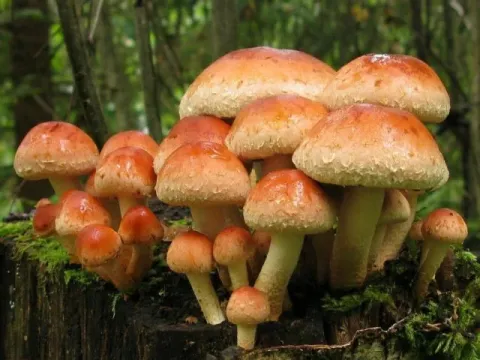
Brick cap
Hypholoma sublateritium
The primary sign of infection is the appearance of dense clusters of mushrooms at the base of trunks or on stumps, featuring a distinct brick-red or reddish-brown cap.
What the section contains
Brick cap
Internally, the pathogen causes white rot, leading to the gradual decomposition of cellulose and lignin within the tree's vascular and structural tissues.
Affected wood often displays a characteristic marbled pattern with dark, irregular lines, which are zones where the fungus has compartmentalized its growth.
Visible decline in the tree’s overall health includes yellowing of the foliage, thinning of the canopy, and the dieback of branches, indicating root or trunk impairment.
Over time, the affected wood loses its density and integrity, becoming spongy and brittle, which significantly reduces the tree's mechanical strength.
The causal agent is Hypholoma sublateritium, a wood-decaying basidiomycete fungus that typically functions as a saprotroph but acts as a facultative parasite.
The fungus releases extracellular enzymes that degrade the structural components of wood, allowing the mycelium to penetrate deeper into the sapwood and heartwood.
Dissemination occurs primarily through basidiospores, which are spread by wind currents and colonize wounded or susceptible bark areas.
The organism is biologically adapted to thrive on decaying organic matter but can easily transition to attacking living trees weakened by stress or injury.
As a resilient pathogen, the fungus can persist in soil or dead wood for extended periods, serving as a constant reservoir for new infections in a garden or forest.
High humidity levels and consistent moisture are the most critical environmental triggers for the germination of fungal spores and the development of mycelia.
The presence of open wounds, such as pruning cuts, frost cracks, or mechanical damage from tools, provides an easy entry point for the fungal spores.
Moderate temperatures during the active growing season facilitate the fungus’s metabolic activity and accelerate the colonization process within the woody host.
Poorly ventilated and overcrowded planting areas lead to stagnant, humid air, which prevents bark surfaces from drying and encourages the establishment of the fungus.
Weakened host trees, due to poor soil conditions or secondary pest attacks, are less capable of defending themselves against the encroachment of the fungus.
The most severe damage caused by this fungus is the compromise of the root system and the base of the trunk, significantly increasing the risk of windthrow.
Water and nutrient transport are severely impaired as the fungus destroys the vascular integrity of the tree, leading to reduced growth and productivity.
In orchards, infection often necessitates the complete removal of the affected tree, resulting in both economic losses and the need for site remediation.
Timber value is completely lost in infected trees, as the wood becomes degraded, soft, and unsuitable for any structural or carpentry use.
The fungus functions as an persistent source of infection, putting neighboring healthy trees at risk if sanitary measures are not implemented promptly.
Effective management begins with strict sanitation, including the thorough removal and destruction of stumps and decaying wood that harbor the fungus.
All pruning cuts and bark wounds should be treated immediately with appropriate wound dressings or fungicides to prevent opportunistic spore colonization.
Improving the tree’s growing environment, such as ensuring proper soil drainage and providing balanced nutrition, helps enhance the plant's natural resistance.
Regular inspections of the base of the tree and root zone allow for early detection of mushroom clusters, enabling intervention before extensive internal damage occurs.
- Remove all dead stumps near healthy trees.
- Use sharp tools to minimize wound surface area.
- Ensure adequate spacing between trees to improve air circulation.