
Bretziella
Bretziella
The disease is caused by the fungus Bretziella fagacearum, formerly known as Ceratocystis fagacearum. This destructive ascomycete acts as a systemic pathogen, primarily targeting the vascular system of oak species.
What the section contains
Bretziella
The fungus colonizes the xylem, where it produces enzymes and toxins that disrupt the water-conducting vessels. As the infection progresses, the tree reacts by forming tyloses, which ultimately block the flow of water and nutrients.
A distinctive feature of this pathogen is the development of fungal mats beneath the bark of infected trees. These structures are essential for the production of spores and the recruitment of insect vectors.
Spore transmission occurs through two primary pathways: long-distance movement via insects attracted to fungal mats, and short-distance spread through root grafts between adjacent trees.
Due to its high virulence, the fungus can overwhelm a host tree's defense systems very rapidly, leading to complete vascular collapse and subsequent tree death within a single growing season.
The most prominent sign of Oak Wilt is the sudden onset of leaf wilting, starting from the upper canopy and moving downwards. Leaves often turn yellow or bronze and drop prematurely while still retaining some green color.
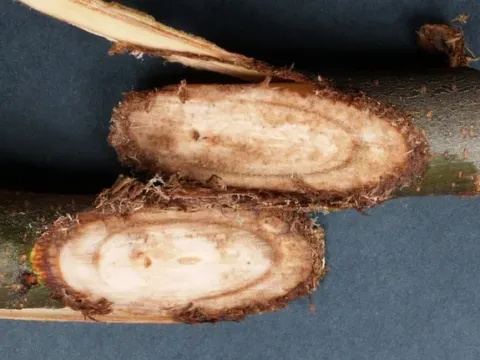
Internal examination of branches or the main trunk reveals dark brown or black discoloration in the sapwood. This staining is caused by the obstruction of vessels and the plant's physiological response to the fungal intrusion.
In later stages of the disease, pressure pads known as fungal mats form under the bark, eventually causing the bark to crack. These mats are the primary sites where the disease is transmitted to other trees.
Infected trees often die in clusters, as the fungus spreads steadily through interconnected root systems, creating expanding zones of mortality in the forest canopy.
Unlike drought, which typically causes gradual browning, Bretziella causes a swift collapse that is difficult to misinterpret once the symptoms become generalized across the tree.
High temperatures during the spring and summer months provide optimal conditions for fungal growth. Warmth accelerates the colonization of the vascular system and increases the activity of insect vectors.
Mechanical injuries to the bark, caused by storms, pruning, or forest equipment, provide entry points for spores carried by insects. Avoiding injury to trees during the growing season is crucial.
The density of oak stands significantly impacts disease spread, as high concentrations of oaks increase the likelihood of root grafting, allowing the fungus to bypass aerial transmission.
Moist microclimates favor the development and survival of fungal mats on the bark surface, prolonging the period during which the disease can be transmitted to new hosts.
Stressed or weakened trees, suffering from drought, poor nutrition, or insect infestations, exhibit lower resistance and are more prone to successful colonization by the pathogen.
The primary threat of Bretziella is the rapid mortality rate it causes in oak populations. Entire forest ecosystems can be decimated in just a few years, causing severe ecological damage.
The economic impact on forestry and the timber industry is significant, as infected wood often cannot be utilized effectively, and large stands of valuable oaks must be removed to prevent further spread.
The loss of oak trees leads to a reduction in biodiversity, as these trees serve as foundational species providing food and habitat for a vast array of wildlife, from squirrels to various bird species.
Landscape aesthetics are severely compromised, leading to long-term changes in forest composition where oaks are frequently replaced by more opportunistic, invasive, or less valuable plant species.
Managing the aftermath of an outbreak requires substantial investment in sanitation, reforestation, and long-term monitoring, which is often beyond the reach of local forest management authorities.
The most effective strategy for containment is the swift removal of infected trees and a buffer zone of healthy trees to prevent the disease from spreading through interconnected roots.
In areas where root grafting is suspected, using heavy machinery to create deep trenches around the infected zone can effectively sever root connections and stop the local spread of the fungus.
Implementing strict policies against pruning or logging during the period of peak insect activity—specifically in spring—is vital to prevent attracting vectors to fresh wounds.
Monitoring programs utilizing pheromone traps are employed to manage populations of insects that act as disease vectors, thereby reducing the risk of new infection outbreaks in high-risk areas.
Regulatory measures including quarantine restrictions on the movement of unseasoned firewood and raw timber from infected zones are essential to curb the disease's geographic expansion.