
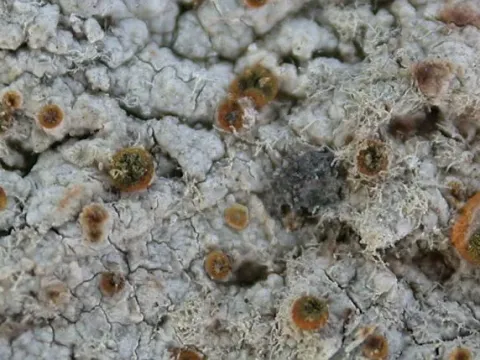
Brigantiaea leucoxantha
Brigantiaea leucoxantha
Brigantiaea leucoxantha is a species of crustose lichen belonging to the Brigantiaeaceae family. It is essential to clarify that it is not a pathogenic organism in the agronomic sense and does not cause infectious plant diseases.
What the section contains
Brigantiaea leucoxantha
This lichen is a complex symbiotic association between a fungus and an alga. It utilizes the tree bark purely as a physical substrate for anchoring and does not derive nutrients from the tree itself.
Unlike parasitic fungi, it does not penetrate the cambium or wood, meaning it does not disrupt the tree's internal physiological processes or sap flow.
The lichen's thallus is tightly adhered to the bark surface, making it appear as a permanent crust, which is a common characteristic of many epiphytic lichen species.
Its presence is primarily an ecological indicator of the tree's environmental conditions rather than an active pathological infection of the plant host.
The primary symptom is the emergence of pale, yellowish-white to greenish-grey patches on the surface of the bark. These patches are crust-like and have a dense, slightly rough texture.
Unlike disease lesions, the lichen does not cause bark necrosis, cracking, or soft rot beneath the affected area; the underlying bark typically remains intact.
The lichen spreads in circular or irregular patterns, gradually covering larger areas of the trunk and primary branches if left undisturbed for several years.
Under magnification, the lichen surface appears consistent and firm, distinguishing it from superficial fungal blooms or powdery mildews.
The presence of Brigantiaea leucoxantha is most common on older or mature trees where bark turnover is slow, as rapidly growing bark prevents the lichen from establishing a stable base.
Lichen development is highly dependent on environmental moisture levels. Orchards with high humidity, poor air circulation, and low light intensity are the most prone to colonization.
Trees located in shaded areas of a garden are particularly susceptible to the growth of this lichen compared to those in full sun.
A decline in the tree's vigor often leads to slower bark renewal, creating a perfect habitat for the lichen to settle and expand its surface area.
Dense canopies that prevent sunlight from hitting the main trunk significantly contribute to the development of Brigantiaea leucoxantha populations.
Proximity to damp areas or regions with frequent, prolonged rainfall promotes the conditions necessary for the dispersal and survival of lichen spores on bark surfaces.
The lichen is non-parasitic and generally harmless to the tree's health. It does not compete for resources or block necessary metabolic functions in the bark.
However, an extremely thick layer of lichen can hold excessive moisture against the bark, which may create a localized environment conducive to secondary opportunistic fungal infections.
The physical structure of the lichen can provide shelter for overwintering pests, such as small mites or scale insects, which may indirectly impact the tree's health.
Large colonies can be visually unappealing, which may be a concern for growers interested in the aesthetic management of their orchards or nursery stock.
Their presence is a reliable diagnostic signal indicating that the tree may need improved vitality, better pruning, or a more optimal nutrient regimen to boost its resilience.
The most effective strategy to manage lichen is to improve tree vigor through proper fertilization and watering, which encourages more frequent bark shedding and healthy growth.
Regular pruning of the canopy is essential to improve airflow and allow more sunlight to reach the trunk and branches, naturally inhibiting lichen establishment.
For immediate removal, mechanical cleaning of the bark using soft or medium-stiff brushes during humid weather is safe and effective without causing damage to the tree.
Applying traditional horticultural whitewash (lime-based wash) to the trunks in early spring is a proven method to alter the bark surface pH, discouraging lichen recolonization.
In cases of widespread colonization, focusing on long-term orchard hygiene—such as removing debris and thinning dense branches—will naturally reduce the lichen's presence over time.