
Henningsomyces
Henningsomyces
Henningsomyces is a genus of fungi belonging to the Pterulaceae family. In agronomic terms, these fungi are primarily classified as saprotrophs or facultative parasites.
What the section contains
Henningsomyces
The pathogen is a microscopic basidiomycete that produces characteristic tubular or club-shaped fruiting bodies. It rarely acts as a primary pathogen for healthy, vigorously growing agricultural crops.
The fungus specializes in decomposing lignin and cellulose in dead plant tissues. In agroecosystems, it is most commonly found on severely weakened plants or crop residues lying on moist soil.
The biology of Henningsomyces is closely related to the process of humification, where the fungus actively colonizes organic substrates using an enzyme system to break down complex polymers.
Dissemination occurs via basidiospores, which are carried by air currents over long distances, settling on surfaces suitable for growth and nutrition.
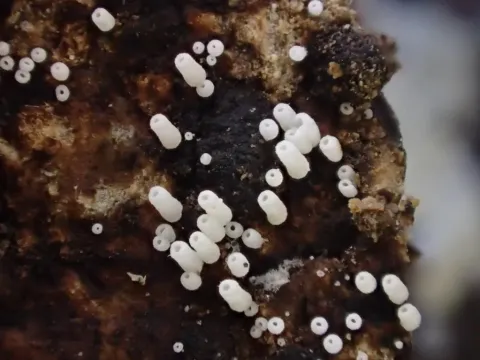
The main visual signs of the fungus are small, narrow, often clustered fruiting bodies that look like tiny tubes or clubs.
The color of the fruiting bodies ranges from whitish to cream or light yellow. Their surface can be smooth or slightly fuzzy when viewed under magnification.
Infection is often localized on the root neck of plants or on fallen stems that are in direct contact with a damp soil environment.
The fungus forms dense clusters that may resemble a thin coating or growth on plant tissue. Unlike many other diseases, it rarely causes rapid wilting of the foliage.
On woody plants or perennials in orchards, the fungus can inhabit bark cracks where ambient humidity levels remain consistently high.
The critical factor for the development of Henningsomyces is a high level of humidity, both in the substrate and in the air layer near the ground.
The fungus prefers moderate temperatures typical of autumn periods or wet summer seasons. It grows actively under limited sunlight conditions.
The presence of large amounts of undecomposed plant material (mulch, straw, debris) on the field creates an ideal breeding ground for colonization by the fungus.
Dense crop plantings that impede airflow and maintain local humidity create a favorable microenvironment for active sporulation.
Reduced plant immunity due to mineral deficiency or exposure to other pathogens makes plants more susceptible to secondary colonization by these fungi.
The primary danger of Henningsomyces lies in the accelerated degradation of organic matter and the potential weakening of crops that already have compromised immunity.
In industrial crop production, this fungus can degrade the quality of crop residues intended for use as mulch or fertilizer if conditions are not managed.
When colonizing woody plants, the fungus contributes to bark degradation, providing entry points for more aggressive pathogens and pests.
While the fungus is rarely the sole cause of crop failure, its mass presence indicates poor agricultural management and a high risk of infectious background.
In greenhouse vegetable production, the development of such fungi may signify poor sanitary conditions and excessive humidity in the soil layer.
The primary control measure is strict adherence to crop rotation practices and timely removal of plant residues from the field after the growing season.
Ensuring adequate ventilation in plantings through proper spacing and weeding significantly reduces the risk of mass fungal reproduction.
Fungicides are rarely required for this specific genus; agronomic practices are usually sufficient to prevent significant colonization.
It is important to monitor soil moisture levels, avoiding water stagnation, which serves as a trigger for spore germination for many basidiomycetes.
- Disinfect agricultural tools regularly.
- Provide balanced fertilization to support plant health.
- Avoid excessive moisture during irrigation.
- Ensure effective greenhouse ventilation.
- Remove diseased plant remains away from the field.