
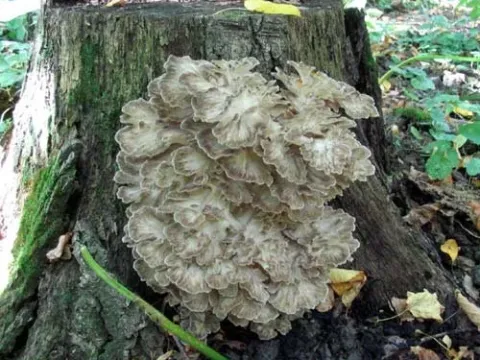
Hen of the woods
Grifola
The causative agent of this disease is the fungus Grifola frondosa, a member of the Meripilaceae family. It acts as a parasitic wood-decay fungus that primarily causes a destructive white rot.
What the section contains
Hen of the woods
The mycelium colonizes the root system and the base of the tree, systematically breaking down lignin and cellulose. This process compromises the internal structure of the tree, leading to significant weakening.
It is an obligate parasite that thrives by exploiting wounds or weaknesses in mature trees. The fungus produces large, distinctive fruiting bodies that are essential for the production and dispersal of spores.
In forest ecosystems, the fungus can persist for many years within old stumps or underground root systems. It spreads both via airborne spores and direct vegetative contact between roots of neighboring trees.
The disease process is characterized by a long period of internal colonization, making it difficult to detect before visible symptoms appear. Eventually, the structural integrity of the host is severely compromised.
The most visible symptom is the presence of large, tufted fruiting bodies at the base of the trunk. These clusters of overlapping caps are a clear indicator of the fungal presence.
Wood decay becomes evident as the interior turns into a soft, fibrous, and pale mass. This degradation drastically reduces the density and strength of the timber in the infected area.
As the root system fails, the tree exhibits symptoms of crown decline, including yellowing leaves, premature shedding, and the death of individual branches. The canopy becomes sparse and stunted.
Advanced stages of the disease lead to hollows at the base of the trunk, which may be detected by tapping the wood. This structural failure often results in trees leaning or falling during windstorms.
Root system inspection may reveal dark, decaying roots covered in fungal mycelium. This damage inhibits the tree's ability to absorb water and essential nutrients from the soil.
The pathogen thrives in environments with high soil moisture and moderate temperatures, often found in dense woodland areas. These conditions facilitate the germination of spores and mycelial growth.
Stagnant water near the base of the tree creates a perfect microclimate for the infection to take hold. Poor drainage is a significant contributor to the spread of the disease.
Mechanical damage to roots or bark provides the necessary entry points for the fungus. Forestry operations, if conducted without care, can inadvertently spread the infection to healthy trees.
The accumulation of woody debris and organic matter in the forest litter layer provides a sustained reservoir for the pathogen. A high density of susceptible trees allows for rapid localized spread.
Minimal light penetration in mature forests helps maintain the humidity levels preferred by the fungus. Such conditions ensure the long-term survival of the infection within the ecosystem.
The primary harm caused by this fungus is the significant reduction in timber quality and volume in hardwood species like oak. It essentially turns valuable wood into unusable decayed material.
The risk of windthrow poses a major safety concern, as infected trees can collapse unexpectedly. This is particularly problematic in managed forests and urban parks frequented by people.
The disease destabilizes the forest community by creating gaps in the canopy, which may trigger unintended changes in the local vegetation composition and habitat structure.
Economic losses in the forestry sector are substantial due to the need for early harvesting and the loss of merchantable timber. Management costs for monitoring and removal are also high.
Ecosystem services provided by mature trees are lost as they succumb to the decay. This reduces the overall biodiversity and resilience of the affected forest stand.
Management focuses on the removal of infected trees and their root systems to eliminate the source of the pathogen. Stump removal is critical to preventing the survival of the fungus.
Preventative care includes minimizing physical damage to the trunk and roots during forest operations. Protective coatings on any necessary wounds can help prevent fungal colonization.
Improving soil drainage around vulnerable trees can create an environment less favorable to the fungus. This approach is highly effective in parkland and ornamental settings.
Regular monitoring of forest health allows for the early detection and quarantine of infected areas. This helps to limit the geographic spread of the disease within the forest.
Choosing resistant species for reforestation projects is the most sustainable long-term strategy. Promoting a diverse mix of tree species can naturally reduce the risk of large-scale outbreaks.