
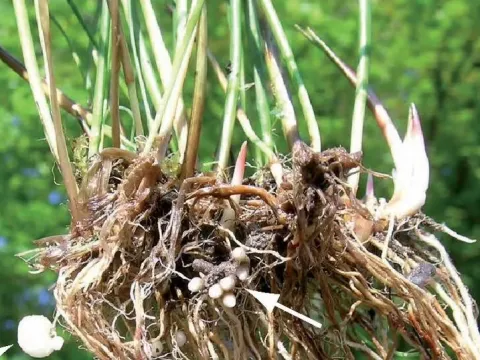
Entorrhiza
Entorrhiza
The disease is caused by fungi belonging to the genus Entorrhiza, which are specialized basidiomycetes. These fungi are obligate parasites that infect the roots of various plants, triggering the development of gall-like structures in their tissues.
What the section contains
Entorrhiza
The pathogen utilizes the plant's resources to complete its life cycle within the root tissues. Once the spores reach maturity inside the galls, they are released into the soil when the plant tissue decays, allowing the fungus to survive in the environment for multiple seasons.
The primary symptom of an Entorrhiza infection is the appearance of distinct galls or swellings on the root system. These galls can vary significantly in appearance, ranging from small, individual nodules to large, irregular tumor-like masses that distort the roots.
Above ground, infected plants often exhibit stunted growth, chlorosis, and wilting, as the root system's ability to uptake water and essential nutrients is severely compromised by the gall formation. In severe cases, the plants may die prematurely due to nutrient deficiency.
Entorrhiza is primarily a soil-borne disease, meaning it spreads through contaminated soil and water. High soil moisture levels significantly enhance the germination of fungal spores, facilitating their movement toward susceptible roots.
The presence of a persistent inoculum in the soil is a key factor for infection outbreaks. Poor drainage and continuous monocropping practices create the most favorable conditions for the disease to spread rapidly across a field or garden area.
The economic impact of Entorrhiza is driven by the significant reduction in crop yield and quality. When roots are heavily infected, the plant's overall vigor decreases, making it less resilient to environmental stress and other potential pathogens.
Furthermore, root galls create necrotic sites that can be easily invaded by opportunistic bacteria and other fungi, leading to severe root rot. This not only decreases immediate productivity but also poses a long-term risk for future plantings in the same soil.
Effective management of Entorrhiza focuses on rigorous cultural practices rather than chemical treatments, which are rarely effective. Implementing a long-term crop rotation cycle is the most critical strategy to reduce the pathogen population in the soil.
- Avoid planting susceptible crops in known infested areas.
- Ensure proper field drainage to reduce soil moisture.
- Sanitize farming equipment to prevent spreading spores between fields.
- Remove and destroy all infected plant residues after harvest.
- Use certified disease-free seeds or transplants to avoid initial infestation.