
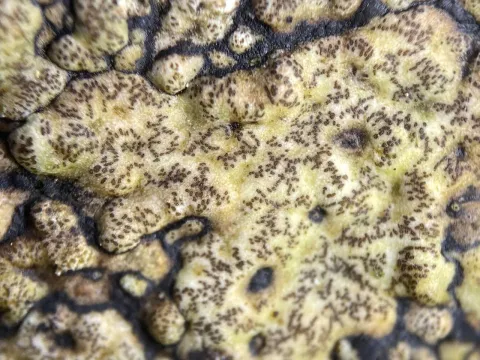
Enterographa crassa
Enterographa crassa
Enterographa crassa is a species of crustose lichen belonging to the Roccellaceae family. It is vital to note that this organism is not a plant pathogen in the traditional sense, but an epiphyte that inhabits tree bark.
What the section contains
Enterographa crassa
The lichen exists as a symbiotic association between a fungus and an alga. It obtains nutrients from the air and moisture rather than parasitizing the host tree's sap or tissues.
The organism develops by slowly expanding its thallus over the bark surface. It is specifically adapted to environments with moderate light levels and consistent moisture.
Its biological cycle is closely tied to the texture of the bark and the microclimate surrounding the tree. Enterographa crassa does not actively kill the tree, but rather occupies an available niche on its surface.
From an agronomic perspective, the presence of this lichen serves primarily as an indicator of air quality and microclimatic conditions within the orchard or garden environment.
The primary symptom of the presence of this lichen is the appearance of flat, crust-like patches on the bark. These patches typically range from white to gray-green or yellowish-ochre in color.
The thallus is very thin and closely appressed to the bark, making it look almost like part of the tree surface itself. Small, elongated reproductive structures called apothecia may be visible under closer inspection.
The lichen is most commonly found on the shaded or north-facing sides of tree trunks, where moisture remains for longer periods, providing a stable habitat for growth.
The underlying bark remains intact beneath the lichen. However, in areas with high density, the visual texture of the bark may appear uneven or patterned by the lichen's colony growth.
During wet weather, the colors of the lichen become more vivid, making established colonies easier to identify and monitor within the planting area.
High humidity and consistent moisture are the most critical factors for the development of Enterographa crassa. Dense canopy structures often trap moisture, facilitating lichen expansion.
Reduced airflow due to overcrowded planting schemes creates a perfect environment for the colonization of this lichen, as surfaces stay damp for extended periods.
The specific acidity and texture of the bark play a secondary role. Trees with rough, deeply fissured bark are more likely to host the lichen compared to those with smooth, rapidly exfoliating bark.
Spore dispersal is primarily wind-driven, allowing the lichen to colonize adjacent trees once a suitable microclimate is established in the area.
Low light intensity, typical of dense, unmanaged forests or poorly pruned orchards, is a prerequisite for the significant spread of this species.
While the lichen is not a parasite, heavy colonization can inhibit gas exchange by covering the lenticels on the tree bark, which are necessary for the tree's respiration.
The lichen's thick crust provides a sheltered micro-habitat that can harbor orchard pests, such as scales or mites, during their overwintering stage, making pest management more difficult.
Prolonged moisture trapped under dense lichen patches may lead to secondary fungal growth, which could potentially degrade the bark over time if the tree is already stressed.
The aesthetic impact of extensive lichen growth can be a concern for nursery owners and gardeners, even if the primary physiological health of the tree remains largely unaffected.
In cases of extremely dense coverage, the monitoring of the bark for early signs of more serious diseases or physical injuries can become physically impeded by the lichen layer.
The most effective management strategy is to prune trees to improve airflow and increase sunlight exposure, which dries out the trunk and reduces the lichen's preferred habitat.
Mechanical removal using a stiff brush during damp weather is a safe and effective way to clean the trunk without damaging the underlying bark tissues.
Applying a lime wash or a specialized copper-based treatment can help sanitize the bark surface and prevent the re-establishment of lichen colonies in the short term.
Maintaining the overall vitality of the trees through proper fertilization and pest control ensures that the bark remains healthy and less conducive to heavy lichen accumulation.
- Improve canopy aeration through pruning.
- Manual cleaning of the bark surface.
- Application of white lime wash for trunks.
- Balanced fertilization to boost host plant vigor.