
Phomopsis seed decay
Didymella longicolla
The disease is caused by the fungus Didymella longicolla (anamorphic stage: Phomopsis longicolla). This pathogen belongs to the Ascomycota phylum and can survive for long periods in soil, crop residues, and infected seeds.
What the section contains
Phomopsis seed decay
The fungus affects both cultivated and wild soybean species, causing severe physiological disruption within plant tissues. The infection spreads via conidia and ascospores dispersed by wind or rain splashes.
Infected seeds serve as the primary source of initial inoculum, with mycelium capable of surviving for several years. The pathogen enters plant tissues through stomata, wounds, or directly through the epidermis.
Inside the host, the fungus develops systemically, colonizing stems, petioles, and pods. The pathogen's life cycle is closely linked to environmental humidity and the availability of host tissues.
The high adaptability of Didymella longicolla allows the pathogen to transition rapidly from a saprophytic lifestyle on debris to an active parasitic phase during the soybean growing season.
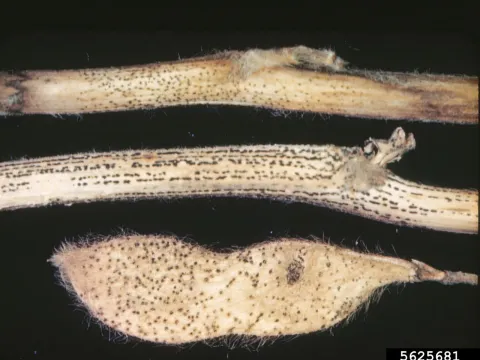
Initial symptoms typically appear during the flowering or pod-filling stages. Brown or dark-gray lesions of irregular shape develop on stems, particularly near the nodes where petioles attach.
Numerous small, black specks known as pycnidia (the fungus's fruiting bodies) eventually form in the center of these lesions. Over time, these spots expand, often girdling significant portions of the stem.
Leaves on infected plants may turn yellow and wither prematurely, while petioles become brittle and break easily. In severe cases, stems crack, which disrupts nutrient and water transport throughout the plant.
The disease also affects the pods, leading to underdeveloped seeds. The pods themselves may become discolored and covered in brown spots, while internal seeds often appear shriveled and coated in white fungal mycelium.
- Darkened stem lesions near nodes.
- Presence of black pycnidia on stems.
- Premature leaf senescence.
- Seed shriveling and reduced size.
- Tissue disintegration at the stem base.
The development of Phomopsis seed decay is highly dependent on meteorological conditions during critical soybean growth stages. Moderately warm, wet weather is most conducive to the disease.
Optimal temperatures for spore germination range from +20°C to +25°C, coupled with relative humidity levels exceeding 80%. Under these conditions, the incubation period is significantly shortened.
The flowering and pod-filling phases are the most critical periods for infection. Excessive soil moisture and poor airflow within dense canopies facilitate the rapid spread of secondary infections.
Poor agricultural practices, such as high planting densities and inadequate field aeration, create a microclimate that promotes aggressive fungal colonization.
Intermittent rainfall during the second half of the summer triggers mass spore release, often leading to epiphytotic levels of the disease in commercial soybean fields.
The economic impact of this disease is significant, primarily due to reduced crop yields and diminished seed quality. Infested seeds suffer from lower germination rates and poor vigor.
The disease causes a sharp reduction in 1000-seed weight because nutrient transport to the developing pods is severely impaired. Furthermore, the oil and protein content of the harvested grain is significantly lowered.
Infected seeds pose a serious risk for subsequent seasons, as they serve as the primary vehicle for pathogen introduction into clean fields. Early-season infections can lead to poor stand establishment and seedling death.
Weakened, brittle stems complicate mechanical harvesting, leading to increased grain losses in the field during operations.
Economic damage includes direct yield loss, increased costs for fungicide applications, and the loss of potential market value due to damaged seed quality.
Managing Phomopsis seed decay requires an integrated approach that combines cultural, chemical, and genetic strategies to minimize disease impact.
The most crucial preventive measure is the use of high-quality, certified seeds that have been laboratory-tested to ensure they are free from the pathogen.
Implementing a crop rotation strategy, with a break of at least 3-4 years before planting soybeans again, is highly effective in reducing the soil-borne inoculum load.
Deep tillage to bury crop residues is mandatory, as this reduces the survival potential of the fungus during the winter months.
Chemical control includes the mandatory use of effective seed treatment fungicides, supplemented by well-timed foliar sprays during the budding and flowering stages if environmental conditions favor disease development.