
Phomopsis stem blight
Phomatodes nebulosa
Description
Symptoms
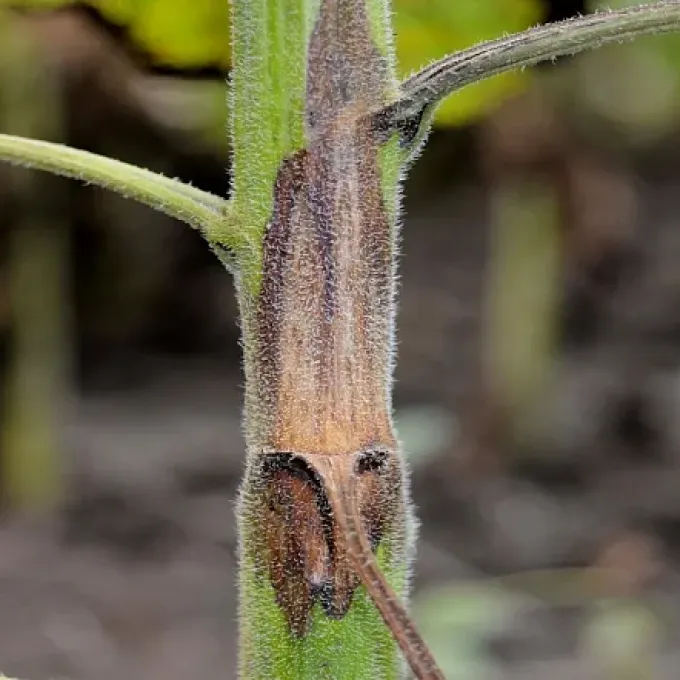
The initial symptoms of the disease appear as light gray or brown lesions with dark, defined margins on stems, leaf petioles, and pods of host crops.
As the infection progresses, small black dots—pycnidia—form within the necrotic lesions. These are often arranged in concentric circles or clustered randomly.
Stem infection leads to thinning and weakening of the plant structure, which frequently causes lodging and disrupts nutrient flow, leading to premature wilting of the top parts of the plant.
In legumes, the disease causes sunken dark spots on pods, which penetrate into the seeds, resulting in deformation and poor seed quality.
In high-humidity conditions, a grayish mass of fungal spores may become visible on infected parts, serving as a distinct diagnostic feature of the disease.
Pathogen
The disease is caused by the fungus Phomatodes nebulosa (formerly Phoma nebulosa), a deuteromycete that persists in crop residues, soil, and seeds. It is a highly resilient pathogen capable of surviving for several seasons.
The mycelium develops within plant tissues, eventually infiltrating stems and pods. The pathogen produces numerous pycnidia, which act as the primary source of secondary inoculum throughout the growing season.
Spores are dispersed by wind, rain splashes, and insects, allowing the fungus to spread rapidly across fields. Phomatodes nebulosa is known for its ability to adapt to varying environmental conditions.
The lifecycle is closely linked to the host plant's health; stressed plants are significantly more susceptible to infection. Preventive strategies focus on minimizing pathogen survival in the field.
Biological complexity, including multiple spore-producing stages, makes chemical management challenging, requiring strategic timing for fungicide applications.
Conditions for development
The development of the fungus is favored by high humidity and moderate temperatures, typically ranging from 18 to 25 degrees Celsius.
Dense canopies that restrict airflow and maintain a humid microclimate are particularly vulnerable, especially when leaf wetness persists due to rain or dew.
Mechanical injuries, pest damage, or sunburns on plant surfaces act as entry points for the pathogen, accelerating the infection process significantly.
Failure to implement proper crop rotation, such as returning susceptible crops to the same soil within a short window, allows the pathogen population to build up.
Extended periods of rainfall during flowering and pod formation are critical risk factors that often lead to widespread outbreaks across the entire field.
Why it matters
The economic impact of Phomopsis stem blight is substantial, with yield losses ranging from 20 to 40 percent depending on disease severity and environmental factors.
Stem infections compromise the plant's metabolic processes, resulting in stunted seed development, lower seed weight, and reduced overall quality of harvested produce.
Infected seeds can act as vectors for the disease, leading to poor emergence, reduced germination energy, and compromised seedling vigor in subsequent seasons.
Necrotic lesions on pods facilitate secondary bacterial infections, causing decay and rendering the produce unsuitable for long-term storage or processing.
During severe epidemics, the destruction of plant tissues can lead to total crop failure on localized patches, resulting in significant financial losses for growers.
Protection
Effective management begins with strict adherence to crop rotation cycles, which helps reduce the pathogen load in the soil and interrupts the infection cycle.
Using certified, high-quality, and fungicide-treated seeds is the fundamental step in preventing primary infections and ensuring healthy seedling establishment.
- Deep incorporation of crop residues into the soil to promote rapid decomposition.
- Applying balanced fertilizer programs to enhance plant vigor and systemic resistance.
- Integrated pest management to prevent mechanical damage to stems and leaves.
- Targeted application of registered fungicides during active growth stages when conditions are conducive to infection.
Selecting resistant varieties and hybrids is an essential long-term strategy that reduces reliance on chemical sprays and improves production sustainability.
Regular field scouting and monitoring for the first appearance of symptoms allow for early intervention and prevent the disease from reaching critical epidemic thresholds.
Discussion
No discussions yet — be the first.