
Phomopsis seed decay
Diaporthe phaseolorum
The causal agent of Phomopsis seed decay is the fungus Diaporthe phaseolorum, which is a significant pathogen affecting soybean crops globally.
What the section contains
Phomopsis seed decay
This fungus is characterized by its ability to survive on infected crop residues, soil, and infested seeds, making it a persistent threat to soybean production.
The life cycle involves the production of two types of spores: conidia for spreading during the growing season and ascospores for survival during winter.
The pathogen typically enters the host through wounds or natural openings, colonizing the stem and vascular tissues as the plant matures toward harvest.
Different strains of the pathogen exist, varying in their virulence and their ability to infect specific parts of the soybean plant, including stems, pods, and seeds.
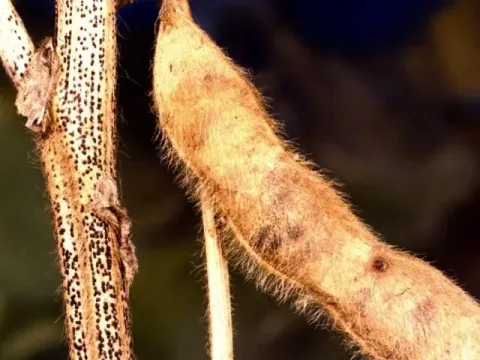
Infection is often recognized by brown to gray necrotic lesions on the stems, frequently appearing around the nodes as the plants approach maturity.
Small black structures called pycnidia, which represent the fruiting bodies of the fungus, can be observed clustered within the necrotic tissue areas.
A distinctive symptom is the premature wilting of leaves, where leaf blades may drop off while the petioles remain attached to the main stem.
Pods infected by the fungus exhibit discoloration and small lesions, which eventually lead to poorly filled or shriveled pods with reduced seed size.
Infected seeds often appear cracked, chalky, or white and shriveled, and in severe cases, a dense white mycelial mat may cover the surface of the seeds.
Disease development is strongly favored by prolonged wet and humid conditions, especially during the pod-filling stages of soybean growth.
Moderate temperatures ranging from 20 to 25 degrees Celsius provide the ideal thermal environment for the fungus to grow and sporulate rapidly.
Poor crop rotation practices, where soybeans are planted consecutively on the same fields, allow the pathogen to build up in the soil and residues.
High planting density contributes to the spread of the disease by creating a closed canopy with high humidity and reduced air movement between plants.
The presence of weeds within the field can act as an alternative host, supporting the fungus even when the primary soybean crop is not present.
Phomopsis seed decay is a major factor in yield reduction, directly affecting both the quantity and the physical quality of the harvested soybean grain.
The infection disrupts the translocation of nutrients to the seeds, resulting in lower oil content, reduced seed weight, and overall poor crop development.
Seed quality degradation makes the harvest unsuitable for processing or for use as high-quality seed material for the next planting season.
Yield losses due to Phomopsis can be substantial, often reaching levels that significantly impact the economic profitability of the farming operation.
Emergence issues are common when infected seeds are planted, leading to uneven stands and potentially requiring expensive reseeding of the fields.
The foundation of effective control is the use of high-quality, disease-free seed that has been treated with appropriate fungicides before planting.
Implementing a strict crop rotation program, with a break of at least three to four years, is essential to break the infection cycle in the soil.
Tillage practices that incorporate soybean residues deep into the soil accelerate their decomposition and reduce the amount of inoculum available for infection.
Foliar fungicide applications during the reproductive stages of soybean growth can effectively suppress the disease and protect the developing pods and seeds.
Ongoing field scouting and weed control are critical management steps to minimize the pathogen spread and ensure the health of the soybean crop.