
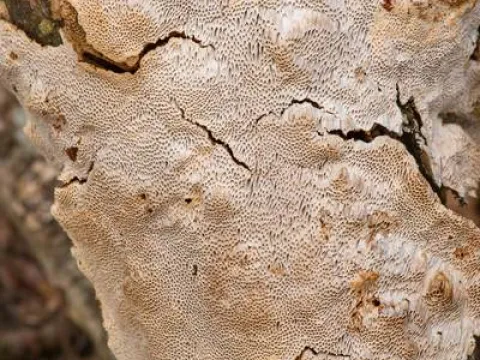
Datronia mollis
Datronia mollis
Datronia mollis is a parasitic fungus belonging to the Polyporaceae family within the Basidiomycota division. As a xylotrophic fungus, it specializes in the decomposition of wood fibers, causing the development of white rot.
What the section contains
Datronia mollis
The life cycle of the fungus occurs primarily within the affected wood, where the mycelium develops. Fruiting bodies form on the surface of the bark or exposed trunk areas, facilitating the reproduction of the species via spores.
This fungus acts as a facultative parasite, capable of transitioning to a saprotrophic lifestyle once the host plant dies. The mycelium actively destroys cellulose and lignin within the wood structure.
The biology of the pathogen allows it to remain viable for extended periods, adapting to various environmental conditions. It can infest both living trees and deadwood or fallen logs.
Dispersal occurs through spores carried by wind, precipitation, and insects that damage the tree bark. The infection enters the tree through wounds and mechanical injuries on the trunks.
The primary external sign of the pathogen's presence is the emergence of specific fruiting bodies on trunks and branches. They typically appear as resupinate or reflexed structures, often clustered or arranged in a shelf-like manner.
The surface of Datronia mollis fruiting bodies is generally velvety, ranging from dark brown to almost black, with a distinct light or whitish margin. The tubular layer features large, angular pores.
As the wood becomes infected, white rot develops inside the trunk, gradually causing the wood to become fibrous. The tissues lose mechanical strength and acquire a bleached or whitish appearance.
In the early stages, symptoms may be hidden beneath healthy bark. However, careful inspection may reveal bark discoloration or exudates at the points where the mycelium has penetrated.
An indirect sign is the presence of hollows or sections of dead bark on the tree, which provide the parasite with access to the internal wood tissues.
Datronia mollis thrives in conditions of high humidity and moderate temperatures. The fungus is most active during periods of prolonged rainfall and high atmospheric humidity.
The critical factor for infection is the availability of entry points, such as mechanical wounds, frost cracks, sunscald, or branch breakage caused by strong winds. The fungus rarely establishes itself on healthy, undamaged bark.
Trees weakened by nutrient deficiency or stressed by other diseases are the most susceptible to the pathogen. A compromised immune system facilitates the rapid spread of the mycelium.
Dense plantings that impede air circulation create a microclimate favorable for spore germination. High humidity within tree canopies or forest stands accelerates the colonization of the wood.
While the fungus can develop across a wide range of temperatures, its activity peaks during the spring, summer, and autumn seasons, when humidity levels remain consistently high.
The primary damage caused by Datronia mollis is the degradation of the wood's structural integrity. The white rot process makes the trunk brittle, significantly increasing the risk of windthrow.
For fruit and ornamental trees, the progression of the disease leads to reduced productivity and the premature death of individual structural branches. Eventually, the entire tree may succumb to the infection.
The fungus obstructs normal sap flow by damaging the plant's vascular system. This results in leaf wilting, reduced growth rates, and the gradual decline of the entire crown.
Economic losses in forestry are associated with the devaluation of timber. Infested logs become unsuitable for construction or woodworking due to the loss of physical properties.
In orchard settings, the harm is manifested by the inability to recover heavily infested trees. Even if external fruiting bodies are removed, the internal infection continues to destroy the trunk from within.
Prevention begins with maintaining overall tree health. It is essential to perform regular sanitary pruning, removing dry, damaged, or diseased branches that could serve as infection hubs.
All pruning cuts and mechanical bark wounds should be immediately sealed with pruning paint or special antiseptic pastes to block fungal spores from entering open tissues.
If fruiting bodies are detected on a trunk, they should be carefully cut away along with a thin layer of wood and destroyed by burning off-site to prevent the dispersal of spores.
Regular fertilization is recommended to strengthen tree immunity. A healthy, vigorously growing tree is better equipped to resist the encroachment of xylotrophic fungi.
In cases of widespread infestation, apply copper-based fungicides, particularly during the autumn season, to protect the bark from cracking and to prevent the entry of new pathogens.