
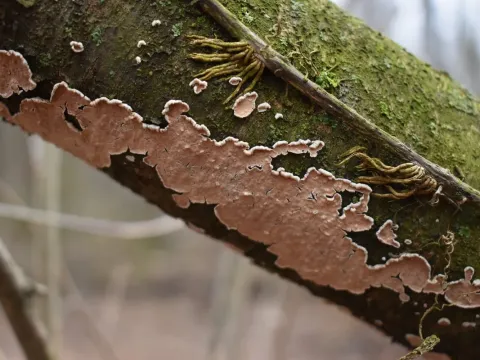
Cylindrobasidium evolvens
Cylindrobasidium evolvens
The causal agent is the wood-decaying fungus Cylindrobasidium evolvens, a member of the basidiomycetes group. This pathogen typically acts as a saprotroph but can function as a weak parasite on various tree species.
What the section contains
Cylindrobasidium evolvens
The fungus infects trees by entering through damaged bark, frost cracks, or improper pruning wounds. Once inside, it colonizes the xylem, where it initiates white rot, effectively breaking down the wood structure.
The mycelium of the fungus spreads through the woody tissue, decomposing lignin and cellulose. This process is essential for the fungus's lifecycle, eventually leading to the development of fruit bodies on the surface of the bark.
Dissemination is facilitated by spores that are released into the air and carried by wind currents. These spores germinate when they land on suitable, moist surfaces, allowing the fungus to colonize new parts of the tree or adjacent trees.
In forest and orchard management, Cylindrobasidium evolvens is often observed on stressed or dying trees, acting as a final decomposer that accelerates the biological degradation of the woody structure.
Early symptoms include the appearance of flat, effused fruit bodies on the bark surface. These bodies are typically creamy, pale yellow, or whitish, often darkening as they age and mature during the season.
Affected wood exhibits the characteristic signs of white rot. The internal structure becomes brittle, light-colored, and stringy as the fungus degrades the structural components of the tree's vascular system.
Bark in the infected areas often shows signs of cracking and peeling. When the bark is removed, white fungal mats or mycelial strands are usually visible, confirming the presence of the pathogen beneath the surface.
The overall health of the tree declines, often characterized by yellowing of leaves, premature leaf drop, and the death of individual branches. The canopy becomes sparse as the tree loses its ability to transport nutrients.
- Effused, creamy-colored fungal fruit bodies on the bark.
- Light, brittle, and decaying wood (white rot).
- Peeling bark exposing white mycelial layers underneath.
- Progressive dieback of branches and crown thinning.
- Development of necrotic zones around the infection site.
High relative humidity and moderate temperatures are primary drivers for the development of Cylindrobasidium evolvens. These conditions ensure that the wood remains damp enough for the spores to germinate successfully.
Open wounds are the most significant risk factor. Whether caused by weather, animals, or human maintenance, any break in the bark provides the fungus with a direct pathway into the nutrient-rich inner wood.
Trees under environmental stress, such as those suffering from drought or nutrient deficiencies, have weakened defense mechanisms, making them significantly more susceptible to successful fungal colonization.
Poor orchard air circulation, often due to high planting density, creates microclimates with stagnant, humid air. This environment is ideal for the rapid proliferation and spread of the fungus among neighboring trees.
Seasonal patterns play a key role, with spring and autumn rain cycles providing the necessary moisture for the fungus to expand its mycelial networks and produce new fruit bodies on the stems.
The primary threat posed by this fungus is the loss of structural integrity. As the internal wood decays, the tree becomes prone to mechanical failure, creating a serious hazard from stem breakage during high winds.
By attacking the vascular tissues, the fungus disrupts the transport of water and nutrients. This inevitably leads to the slow starvation of the canopy, resulting in permanent damage to the tree's productivity and growth.
In orchards, infection leads to reduced fruit quality and yield. If left untreated, the pathogen can spread through the plantation, necessitating the removal of entire trees and leading to substantial economic losses.
The disease is often difficult to eradicate once it is well-established within the trunk. Because it spreads through airborne spores, it poses a recurring threat to the entire orchard population if not managed early.
Management costs are high, involving labor-intensive tree surgery, specialized treatments for wounds, and the expense of removing and properly disposing of highly infected or dead wood to stop the cycle.
Good orchard hygiene is the first line of defense. Maintaining tree vigor through balanced fertilization and appropriate irrigation helps trees build natural resistance to wood-decaying organisms.
Precise pruning is essential; all branches should be removed cleanly without leaving stubs. All wounds over 2-3 cm in diameter must be sealed with specialized pruning sealants to prevent spore entry.
Sanitation involves the prompt removal and burning of any dead or symptomatic branches. When infection is detected, the diseased area should be excised down to healthy wood and disinfected with copper-based solutions.
Regular inspection of the bark is vital for early detection. If fruit bodies are found, they should be mechanically removed and disposed of away from the orchard to prevent further spore dissemination.
Protecting the tree trunk from frost damage using whitewash or protective wraps is an effective preventive measure. Keeping trees free from secondary pest attacks also reduces the number of entry points available to the fungus.