
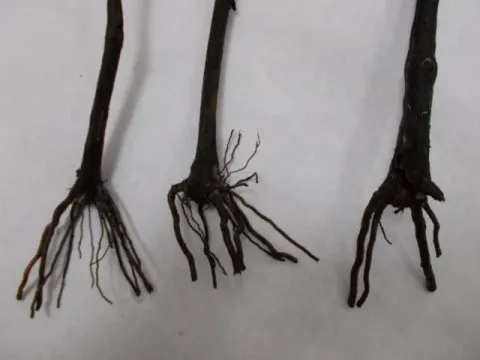
Cylindrocarpon root rot
Cylindrocarpon carneum
The causal agent of the disease is the imperfect fungus Cylindrocarpon carneum (also known under the synonym Neonectria carnea), which belongs to the order Hypocreales. It is a soil-borne pathogen that persists in plant debris and substrate as mycelium, chlamydospores, or conidia.
What the section contains
Cylindrocarpon root rot
The fungus has the ability to exist saprotrophically for long periods, making it highly resistant to unfavorable environmental conditions. The pathogen spreads through contaminated soil, planting material, and through water during irrigation or precipitation.
Microscopically, the pathogen is characterized by the formation of cylindrical or ellipsoidal conidia, often divided by septa. During unfavorable periods, the fungus forms chlamydospores that allow it to survive in deep soil layers for several years.
A biological feature of the species is its distinct ability to infect weakened organisms. Cylindrocarpon carneum often acts as a secondary pathogen, colonizing tissues after other fungal infections or pest damage have already compromised the plant.
The pathogen can secrete specific enzymes that break down root cell walls, facilitating the colonization of host plant tissues. The high metabolic plasticity of the fungus allows it to adapt to various soil types.
The main symptom of the infection is the development of necrosis on the root system, which often has a brown or reddish tint. Roots lose their elasticity, become brittle, and gradually die, leading to impaired nutrition of the above-ground part.
Affected plants exhibit marked growth suppression, premature yellowing, and wilting of lower leaves. During hot hours, leaf turgor decreases sharply, and in cases of severe disease development, the plant may die entirely.
Depressed dark spots may appear on the root collar or lower part of the stem, expanding over time. Under high air humidity, a whitish or pinkish fungal spore coating may appear on the affected tissues.
Upon inspection, the root system looks heavily branched but with multiple foci of decay. Root tissues often show browning on cross-sections, indicating destruction of the plant's vascular system.
In nurseries, the disease manifests as "damping-off," where young plants wilt suddenly in groups. This is often associated with infection of the root collar through micro-cracks or damage caused by insects.
The development of Cylindrocarpon carneum is favored by high soil moisture and moderate air temperatures. The fungus is most active in the range of +15 to +22 degrees Celsius in waterlogged soil.
Stagnant water in the soil creates critical conditions for the spread of the infection. A lack of root aeration makes plants extremely susceptible to fungal spore penetration through root hairs.
Heavy, poorly drained soils are a risk factor for the development of the pathogen. In such conditions, the fungus colonizes the rhizosphere faster and suppresses the natural soil microflora.
Mechanical damage to roots during transplanting or soil cultivation significantly creates entry points for infection. The presence of damage from soil pests also triggers disease outbreaks.
Poor agricultural practices, including excessive nitrogen fertilization, reduce the natural resistance of plants. This leads to excessive tissue growth, which becomes more vulnerable to Cylindrocarpon carneum infection.
The damage caused by Cylindrocarpon root rot manifests as a sharp decrease in the commercial value and productivity of crops. In cases of severe infection, total loss of young plants is observed, requiring field replanting.
The disease impairs vascular conduction, preventing the plant from receiving sufficient water and nutrients. This inevitably leads to yield reduction and poor fruit quality.
Long-term root system damage makes plants vulnerable to other types of root rots. Complex infection often leads to the death of perennial crops in orchards and nurseries.
Economic damage includes the cost of fungicide applications, loss of crop yield, and expenses for reclaiming contaminated soil. In greenhouse environments, the disease can spread throughout the entire rotation cycle.
The infection poses a particular danger to nursery complexes, where high plant density facilitates rapid pathogen transmission from one plant to another.
Effective protection begins with the careful selection of healthy planting material and adherence to crop rotation rules. It is unacceptable to plant crops on plots where mass cases of root rot have previously been noted.
It is necessary to strictly control the irrigation regime, preventing soil waterlogging and stagnant water. An important element is improving soil drainage and ensuring good aeration in the root zone.
Biological control methods include the use of Trichoderma-based preparations, which suppress the development of phytopathogenic fungi in the soil. This contributes to rhizosphere health and increases plant immunity.
Chemical control includes seed dressing and treatment of seedlings with systemic fungicides. The use of specialized fungicides must be carried out strictly according to instructions, taking into account environmental regulations.
Regular disinfection of tools, greenhouses, and growing containers significantly reduces the risk of spore spread. Destruction of crop residues after harvest is a mandatory measure to prevent infection build-up.