
Cudonia
Cudonia
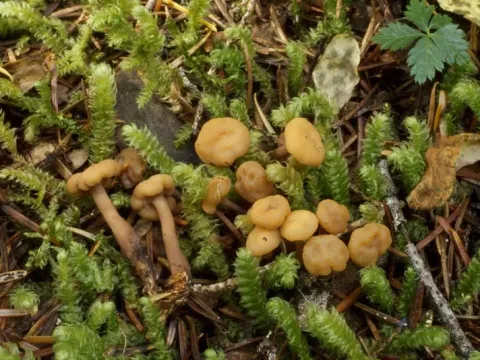
Cudonia, particularly the species Cudonia circinans, appears on the surface of forest litter or on decaying plant debris under coniferous trees. The fungal fruiting bodies look like small gelatinous structures with a saddle-shaped or wavy cap attached to a short stalk.
What the section contains
Cudonia
Visually, the presence of the pathogen is marked by clusters of spore-bearing bodies gathering around tree bases or in areas with high soil moisture. The mycelium penetrates the organic layer, decomposing needles and other forest substrates.
Signs of this pathogen are often overlooked because the fruiting bodies emerge in late summer or autumn. They possess an ochre, grayish, or brownish hue, which makes them blend into the forest floor.
Unlike parasitic fungi that cause tissue necrosis, Cudonia often acts as a saprophyte; however, in high densities, it can inhibit the growth of conifer seedlings.
The primary identification sign is the presence of clusters of spore-forming fungal bodies in the immediate vicinity of the root collars of weakened trees or young seedlings.
The disease is caused by fungi of the genus Cudonia, belonging to the Ascomycota class. These are cup fungi whose lifecycle is closely linked to the decomposition of coniferous litter.
The pathogen's biology involves a mycelium that persists in the soil and plant debris for long periods, remaining dormant under unfavorable conditions.
Reproduction occurs via ascospores, which are ejected into the atmosphere and transported by air currents to adjacent areas, infecting new parts of the forest.
The fungus actively participates in humification processes, but if agrotechnical balances are disrupted or plant immunity is lowered, it shifts to colonizing the root zone.
The genetic structure of the fungus allows it to adapt to a wide temperature range, making it common in almost all temperate coniferous forests.
The development of Cudonia depends directly on soil moisture levels and the presence of a thick layer of coniferous litter, which serves as a nutrient base for the mycelium.
Optimal conditions occur during periods of prolonged rain and moderate temperatures, when high relative humidity is maintained in the lower air layer.
Dense conifer stands where ventilation is restricted create an ideal microclimate for the germination of the pathogen's spores.
The presence of large amounts of decomposing wood and needles in the soil triggers active fruiting, increasing the infection pressure on the plot.
The seasonality of Cudonia development is limited to the period from August to October, when temperatures drop while humidity remains consistently high.
The main harm consists of the fungus competing for soil nutrients, which can lead to stunted growth in young saplings.
During mass development, the mycelium can partially inhibit the microflora essential for normal tree root nutrition, creating a physiological imbalance.
In ornamental conifer nurseries, the appearance of Cudonia may signal poor soil management practices and excessive moisture.
Although the fungus is not an aggressive parasite, its presence facilitates the accumulation of spores that may trigger secondary infections.
Disruption of natural forest restoration processes due to excessive growth of this fungal genus requires professional agronomical monitoring.
To prevent the spread of Cudonia, it is necessary to ensure proper soil aeration and regular clearing of excessive dry needle accumulation from the site.
Preventive soil treatment with biofungicides is recommended to suppress fungal colony development without harming beneficial soil microflora.
Optimizing irrigation regimes in nurseries prevents water stagnation, hindering the pathogen's transition to the active fruiting phase.
Upon detection of infection outbreaks, it is necessary to remove the fungal fruiting bodies and disinfect the topsoil with appropriate fungicidal agents.
- Regular inspection of young plantings for fruiting bodies;
- Maintaining proper planting distance to improve air circulation;
- Monitoring soil pH levels in the root zone.