
Cucurbitaria canker of spruce
Cucurbitaria piceae
The disease is caused by the ascomycete fungus Cucurbitaria piceae, which acts as a pathogen primarily targeting the bark and stems of spruce trees.
What the section contains
Cucurbitaria canker of spruce
The fungus develops within the host tissues, colonizing weakened areas and utilizing nutrients from the living or dying bark to complete its life cycle.
The presence of the pathogen is often signaled by the development of pseudothecia, which appear as small, dense clusters of black fruiting bodies on the surface of infected bark.
These spores are highly mobile and are typically dispersed by wind and rain, allowing the infection to spread rapidly throughout a stand or garden during favorable weather.
As a facultative parasite, the fungus thrives when it finds suitable entry points on trees that are already suffering from environmental stress or lack of vitality.
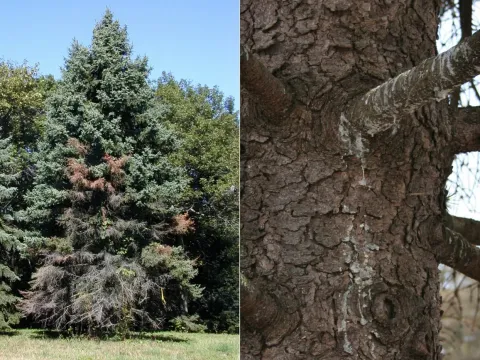
The primary symptom of the disease is the appearance of necrotic lesions on the branches, which eventually lead to the localized death of the bark.
Needles on the affected branches change color, turning from green to yellow, and eventually to a reddish-brown shade before dropping prematurely.
Infected areas of the bark may develop cracks or small open sores, and under close inspection, the dark clusters of fungal fruiting bodies become visible.
The disease causes the affected branches to become brittle and eventually snap, leading to sparse foliage and a visibly thinning tree crown.
Tree resin may accumulate near the margins of the infection site, serving as a desperate physiological defense mechanism against the invading mycelium.
High humidity and stagnant air are critical environmental triggers for the germination of fungal spores and the subsequent infection of new branches.
Spruce trees weakened by drought, soil compaction, or poor nutrient availability are significantly more susceptible to Cucurbitaria piceae.
Physical trauma, such as frost cracks, sunscald, or insect damage, provides the ideal entry points for the pathogen to establish itself in the vascular system.
Dense planting schemes restrict airflow around the tree, creating a microclimate that facilitates the rapid multiplication of the fungus.
Improper care practices, including over-fertilizing with nitrogen or incorrect pruning techniques, can also inadvertently promote the development of the disease.
The cumulative damage caused by the fungus leads to severe dieback of branches, which compromises the overall aesthetic and structural integrity of the spruce tree.
If left unmanaged, the infection can spread throughout the crown, eventually causing the tree to lose its vitality and potentially leading to its premature death.
The disease disrupts the tree's photosynthetic capacity, resulting in reduced growth rates and increased susceptibility to secondary pests and environmental threats.
Once established, an infected spruce acts as a significant reservoir of inoculum, putting other nearby coniferous species at constant risk of infection.
The economic and ecological value of the spruce is degraded as the tree becomes a sickly, unsightly remnant that can no longer serve its purpose in the landscape.
Sanitation is the most effective management tool; infected branches must be pruned back into healthy wood and immediately destroyed to prevent spore release.
Following pruning, all tools must be sterilized, and the cut surfaces should be treated with appropriate fungicides or protective wound dressings.
Implementing a routine preventative spray program using copper-based or systemic fungicides in the early spring and autumn helps suppress potential outbreaks.
Proper silvicultural practices, such as ensuring correct spacing between trees and optimizing soil moisture levels, significantly improve the tree's natural resistance.
Maintaining balanced tree nutrition and protecting spruce trees from insect infestations are essential preventative measures to keep the host resilient against the pathogen.