
Cudonia circinans
Cudonia circinans
Description
Symptoms
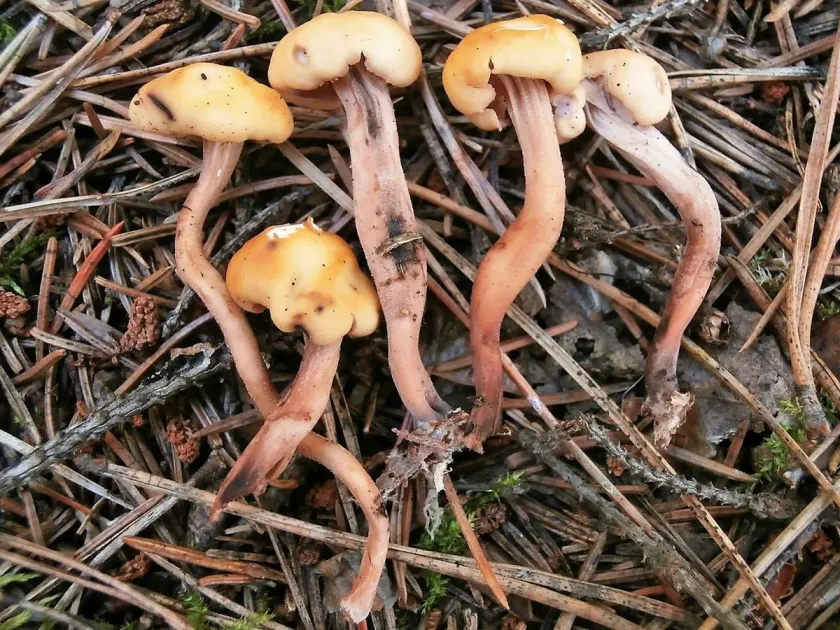
The main visible sign of Cudonia circinans is the presence of its characteristic fruit bodies (apothecia). They appear during the summer and autumn seasons.
The caps are typically rounded or convoluted with a distinct brownish-yellow color. They often have a somewhat gelatinous or tough texture upon maturity.
The stems are often wrinkled and pale. These fungi are known for growing in clusters, sometimes forming groups that are easily noticeable against the forest floor.
There are no associated symptoms such as wilting, chlorosis, or necrosis on nearby plants. The presence of these fungi is strictly localized to the decaying organic layer.
Visual identification requires close inspection of the cap shape and the attachment point of the stem to distinguish it from other related forest species.
Pathogen
Cudonia circinans is a species of fungus within the class Leotiomycetes. It is important to clarify that this organism is not a plant pathogen, but rather a saprotroph.
As a saprotrophic fungus, it functions by decomposing organic matter such as dead conifer needles and leaf litter. It plays an essential role in the forest nutrient cycle.
The fungus develops fruit bodies that emerge from the soil. It does not infect or cause disease in living plant tissues, making it harmless to crops and trees.
From an agricultural and forestry perspective, it is classified as a beneficial decomposer. It does not pose a threat to economic productivity or plant health.
Misunderstandings sometimes arise regarding its classification, but scientific consensus clearly defines Cudonia circinans as a non-pathogenic component of woodland ecosystems.
Conditions for development
This fungus thrives in coniferous forests, showing a specific preference for environments with significant needle litter accumulation.
High moisture levels are crucial for the development of the fruit bodies. Humidity within the lower forest canopy directly influences the growth rate of the colony.
Temperature range also plays a vital role in its life cycle. It prefers cool to moderate temperatures, typically found in temperate forest climates.
The soil structure must be acidic to support the specific decay processes that Cudonia circinans relies upon for its survival.
Seasonal patterns of rainfall drive the appearance of these fungi. They are often most abundant following periods of consistent precipitation throughout the summer months.
Protection
Since Cudonia circinans is not a plant pathogen, no control or protective measures are necessary in forestry or agriculture.
The presence of this fungus is an indicator of a healthy, functioning forest ecosystem with active organic matter decomposition.
Removing these fungi is unnecessary and would disrupt the natural soil-building processes they contribute to within the forest habitat.
No fungicides or chemical interventions should be applied, as they would be ineffective and harmful to the natural biodiversity of the forest soil.
Management should focus on maintaining forest health rather than attempting to eradicate saprotrophic species that provide ecosystem services.
Discussion
No discussions yet — be the first.