
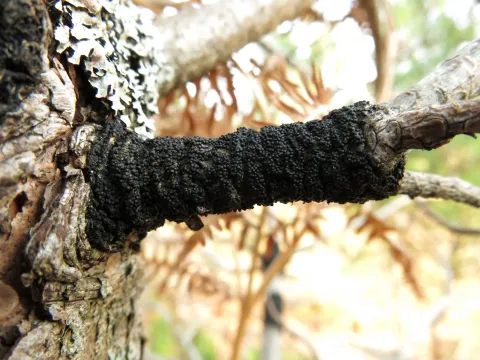
Crumenulopsis
Crumenulopsis
The disease is caused by fungi of the genus Crumenulopsis, most notably Crumenulopsis sororia. These are ascomycete fungi known to affect conifers, particularly species within the Pinaceae family, such as the Scots pine.
What the section contains
Crumenulopsis
The life cycle involves the production of apothecia—small, cup-shaped fruiting bodies that develop on the infected bark. These structures release spores that are dispersed by wind and splashing rain, allowing the pathogen to spread to new hosts.
The fungus penetrates the bark through cracks or wounds, invading the cambium layer. Once established, the mycelium spreads, disrupting the tree’s nutrient and water transport systems, leading to localized cell death and bark necrosis.
The pathogen is often considered a stress-related invader, meaning it effectively colonizes trees already compromised by environmental factors such as drought, nutrient deficiency, or prior damage.
Its ability to remain latent in tissues allows it to persist in a forest stand for extended periods, waiting for environmental conditions—such as high humidity—to become favorable for aggressive growth and reproduction.
The most distinctive symptom of Crumenulopsis infection is the formation of cankers on branches and, in severe cases, the main stem. These cankers appear as sunken, necrotic areas of bark.
Trees frequently exhibit significant resinosis—an excessive flow of resin at the site of the infection—as they attempt to compartmentalize the fungus. This resin often hardens into distinct white or amber-colored crusts.
As the infection girdles a branch, the foliage distal to the canker turns yellow, then reddish-brown, and eventually drops off. This leads to the characteristic dieback of individual branches or the entire crown.
During moist conditions, small, brown, disc-shaped apothecia can be found on the dead or dying bark of the cankered areas. These are the primary indicators of active sporulation.
The underlying wood beneath the cankered bark often shows discoloration or staining, indicating that the fungus has successfully infiltrated the host tissues and is actively degrading the structure.
High moisture levels are the most critical factor for the disease’s development. Frequent rainfall and prolonged high humidity periods provide the necessary moisture for spores to germinate and infect new bark.
Dense, overcrowded plantations with poor air circulation create a localized microclimate that remains damp, facilitating the spread of spores from one tree to another within the stand.
Trees experiencing physiological stress, whether due to poor site conditions, extreme weather, or competition for resources, are significantly more susceptible to infection.
Mechanical damage caused by insects, wildlife, or forestry equipment provides direct entry points for the fungus, making such trees primary targets for initial colonization.
Seasonal patterns also play a role, with spring and autumn—when temperatures are moderate and rainfall is frequent—being the peak periods for infection and fungal activity.
The primary damage caused by Crumenulopsis is branch dieback, which reduces the tree’s photosynthetic capacity, stunts growth, and can eventually lead to the mortality of entire specimens.
Infected trees often become weakened and are significantly more susceptible to secondary attacks by wood-boring insects, such as bark beetles, which can kill a tree much faster than the fungus alone.
In commercial forestry, the disease leads to a loss of timber quality and quantity, necessitating costly sanitary felling and reducing the overall economic yield of the forest stand.
In ornamental and landscape settings, the loss of branches and general crown thinning drastically reduce the aesthetic and functional value of the trees.
The persistent nature of the disease can cause long-term declines in plantation health, requiring intensive management efforts to prevent the pathogen from reaching epidemic levels.
The most effective management strategy is the prompt identification and removal of infected branches or entire trees to reduce the overall inoculum load within the area.
Ensuring optimal planting density and performing regular thinning helps maintain air circulation in the canopy, reducing the humidity levels that favor spore development.
Sanitation practices, such as pruning, should be performed during dry weather to minimize the risk of spreading spores and to allow the tree to heal its wounds effectively.
All tools used during pruning must be thoroughly disinfected with alcohol or other suitable sanitizers between each tree to prevent cross-contamination.
Maintaining tree vigor through appropriate fertilization and water management is essential for creating a resilient stand that can better withstand infection attempts.