
Crucibulum
Crucibulum
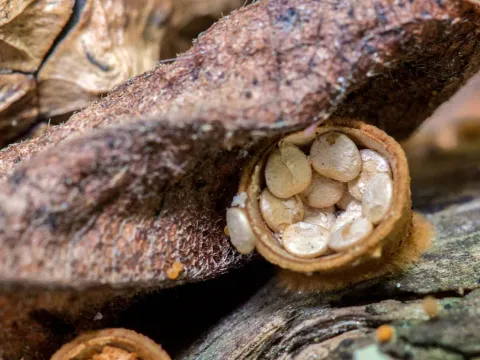
The genus Crucibulum, represented most commonly by Crucibulum laeve, belongs to the family Agaricaceae and is known as a bird's nest fungus.
What the section contains
Crucibulum
These organisms are primarily saprotrophic, meaning they derive their nutrients from dead and decaying organic matter rather than living plant tissues.
They reproduce by forming unique cup-shaped fruiting bodies that contain spore-filled structures known as peridioles.
Biologically, these fungi play a role in the natural decomposition of lignin and cellulose within the top layer of soil or mulch.
While they are not direct pathogens of healthy crops, their presence indicates specific environmental conditions that may be suboptimal for plant growth.
The most distinctive sign is the appearance of small, cup-shaped fruiting bodies, typically measuring less than a centimeter in diameter.
The interior of these "cups" contains several small, disc-like peridioles that act as spore containers, often resembling a tiny bird's nest.
The outer surface of the fruiting body is usually brownish and slightly velvety or hairy to the touch.
Early stages of colonization appear as a patch of white, thread-like mycelium spreading across damp soil, wood chips, or plant debris.
When raindrops land inside the cups, the peridioles are splashed out, allowing the fungus to spread across the surrounding area.
High humidity and moisture are the most critical factors required for the growth and fruiting of this fungus.
It thrives in shaded environments where organic litter, such as straw, wood scraps, or garden mulch, remains consistently damp.
Lack of proper soil aeration and stagnant water levels create the ideal environment for the mycelium to establish itself.
Mild to moderate temperatures, typically between 15 and 22 degrees Celsius, encourage the development of visible fruiting bodies.
The fungus is most frequently observed in late summer or autumn when rainy weather provides the necessary hydration for its life cycle.
While it does not attack living plants, the fungus can deplete soil nutrients, particularly nitrogen, as it breaks down carbon-rich organic materials.
The presence of mass colonies indicates excessive soil moisture, which is often detrimental to the root health of sensitive crop species.
Dense growth on the soil surface can impede natural evaporation and aeration, creating a microclimate that fosters other, more dangerous pathogens.
It can create aesthetic and management issues in nursery and greenhouse settings by signaling poor sanitation or improper irrigation regimes.
The fungus changes the composition of the surface soil, potentially impacting the germination and initial establishment of seeds in affected areas.
The primary control strategy involves improving drainage and adjusting irrigation schedules to reduce moisture levels in the growing medium.
Sanitation is key; remove excess organic mulch, rotting wood, or other debris where the fungus can feed and multiply.
Regular cultivation or shallow raking of the soil surface helps disrupt the fungal mycelium and promotes faster drying.
Introducing beneficial soil microorganisms through biological amendments can help outcompete saprotrophic fungi for resources.
In greenhouses, ensure adequate air circulation and spacing between plants to prevent the formation of the damp conditions required for fungal growth.