
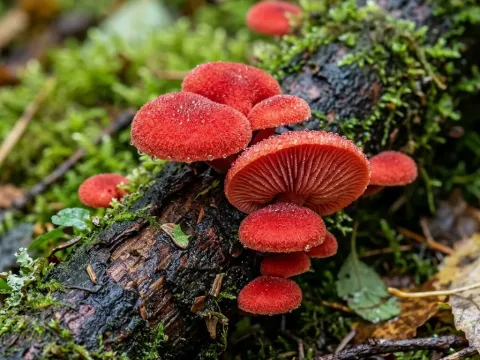
Cinnabar-red crepidotus
Crepidotus cinnabarinus
Cinnabar-red crepidotus (scientific name: Crepidotus cinnabarinus) is a mushroom species within the family Inocybaceae. It is critical to note that it is not a plant pathogen and does not infect healthy living plants.
What the section contains
Cinnabar-red crepidotus
This fungus is classified as a wood-decaying saprotroph. It obtains its nutrition by breaking down lignin and cellulose in dead or severely compromised woody substrates.
In terms of biology, Crepidotus cinnabarinus acts as a decomposer, which is essential for nutrient cycling in forest and garden ecosystems.
The misconception that it is a plant disease arises when observers find its fruiting bodies growing on the bark of weakened trees that are already dying from other causes.
Morphologically, it stands out due to its vivid cinnabar-red color and sessile, kidney-shaped fruiting bodies, though it lacks any parasitic mechanisms to attack living vascular tissues.
The most visible sign of this fungus is the emergence of small, fan-shaped or kidney-shaped fruiting bodies that exhibit a vibrant red or cinnabar coloration.
These fruiting bodies are typically attached directly to the bark or exposed wood of deciduous trees, appearing in clusters rather than singly.
As the spores mature, the surface of the cap or the spore print may take on a brownish hue, which provides a contrast to the otherwise bright color of the mushroom.
The underlying wood generally shows clear evidence of pre-existing decay, including soft texture, bleaching, or structural instability.
Unlike genuine pathogens that create cankers or wilting symptoms, this species leaves the living tissue unaffected, colonizing only the non-living parts of the tree.
High humidity and moisture are the primary factors driving the development of Crepidotus cinnabarinus, allowing mycelium to colonize wood efficiently.
The fungus thrives in shaded environments, such as dense woodlands or neglected gardens where moisture persists on woody surfaces for extended periods.
It prefers mild temperatures, commonly found during the wet autumn months or cool, damp summers when environmental conditions are optimal for fruiting.
Presence of cracks, frost damage, or deep wounds on a tree provides the necessary entry points for the fungus to establish itself in the deadwood tissues.
Airborne spore dispersal allows this species to spread quickly across an area, colonizing any suitable damp woody substrate that has already begun to decompose.
There is no direct damage caused by Crepidotus cinnabarinus to healthy agricultural or ornamental plants.
It should be viewed as an indicator of pre-existing health issues within a tree, such as internal root rot or structural decline caused by other agents.
For economic purposes, the presence of these fungi indicates that the wood has lost its resistance, which could be an issue for timber quality but not for crop yields.
The harm is negligible, as the fungus simply fulfills its ecological role as a recycler of organic material within the plant's immediate environment.
Consequently, there is no justification for chemical intervention or fungicide application against this specific organism, as it is a beneficial part of the ecosystem.
Since the species is not a disease-causing agent for living plants, no specific protective or control measures are necessary.
Effective management is based on general horticultural practices, such as maintaining strong tree health through proper irrigation and balanced nutrition.
Regular sanitation, including the removal of deadwood, pruned branches, and stumps, is the most effective way to limit the presence of saprotrophic fungi in a garden.
Inspecting trees for potential primary infections or pest infestations is recommended if growth of this fungus is frequently noted, to address the underlying tree issues.
- Sanitary pruning of dead branches.
- Clearing woody debris from the orchard.
- Properly treating trunk wounds with protectant agents.