
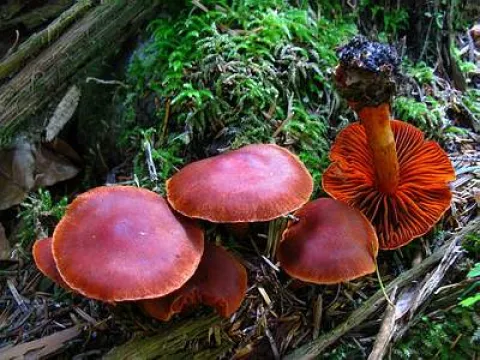
Cinnabar-red webcap
Cortinarius cinnabarinus
The Cinnabar-red webcap is easily recognized by its vibrant cinnabar-red color, which covers the cap, stem, and even the flesh. The cap measures 3–8 cm in diameter, starting as convex and becoming flatter as it matures.
What the section contains
Cinnabar-red webcap
The cap's surface is dry and possesses a fibrous or finely scaly texture, giving it a matte appearance. This distinct coloration is constant throughout the mushroom's development.
The gills are initially the same bright red as the cap but turn rusty-brown as the spores ripen. This color shift is a key identifier for this specific species within the Cortinarius genus.
The stem is robust and cylindrical, often slightly thicker at the base. Like the rest of the fruiting body, it displays an intense red pigment that is very striking in the forest undergrowth.
A cortina, or web-like veil, is present in young specimens, stretching from the cap edge to the stem, and leaving slight reddish, fibrous residues as the mushroom grows older.
Cortinarius cinnabarinus is not a plant pathogen and does not cause diseases in crops. It is a mycorrhizal fungus that forms symbiotic relationships with broad-leaved trees.
The fungus provides essential minerals and moisture to its host trees, while the trees supply the fungus with carbohydrates produced through photosynthesis.
Because it acts as a beneficial symbiont rather than a parasite, it is not considered a threat to agriculture or forestry management practices.
Scientific interest in this species usually revolves around its role in the ecosystem and its potential as a biological indicator of soil health in temperate deciduous forests.
In a farm setting, you will not find this species attacking crops, as its biological requirements are strictly tied to specific mature forest trees.
This species thrives in deciduous forests, where it commonly associates with beech trees, though it can also be found in oak or birch habitats under the right conditions.
The development of fruiting bodies occurs primarily from late summer to mid-autumn, triggered by consistent moisture levels in the forest floor.
It prefers shaded environments where a thick layer of leaf litter provides the necessary protection and nutrients for its underground mycelium network.
Soil chemistry, specifically neutral to slightly acidic conditions, significantly favors the establishment of this fungus in a given forest area.
Proper distribution is achieved through the release of wind-dispersed spores, which germinate only when they encounter the roots of compatible host trees.