
Cinnabar-red chanterelle
Cantharellus cinnabarinus
Description
Symptoms
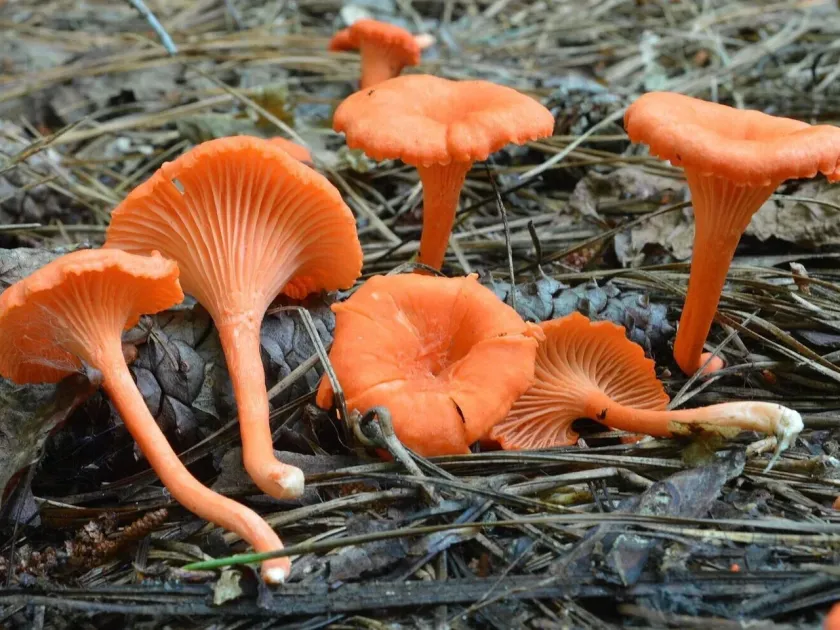
The Cinnabar-red chanterelle is recognized by its distinct and vibrant cinnabar or reddish-orange color, making it easily distinguishable in the wild.
Its cap is typically small, ranging from 1 to 4 centimeters in diameter, often featuring an irregular, wavy, or funnel-shaped margin.
Instead of true gills, the mushroom displays thick, forked ridges that are decurrent, meaning they run down the length of the stalk.
The entire fruiting body, including the flesh, maintains a consistent reddish hue throughout the maturation process of the fungus.
Despite its small size, the mushroom is highly sought after by foraging enthusiasts for its firm texture and mild, pleasant culinary qualities.
Pathogen
It is crucial to clarify that the Cinnabar-red chanterelle is not a plant disease or an agricultural pathogen but a beneficial mycorrhizal fungus.
It maintains a symbiotic relationship with hardwood trees, aiding in nutrient uptake and soil health rather than attacking living plant tissue.
As a non-pathogenic organism, it does not pose any threat to agricultural crops, orchards, or managed landscape plant health.
The scientific classification of Cantharellus cinnabarinus places it firmly within the group of fungi that enhance rather than hinder tree vigor.
Therefore, it is misidentified if categorized as a disease; it is an essential component of healthy forest soil ecology and biodiversity.
Conditions for development
This species thrives in deciduous forests, particularly those with a canopy dominated by oak and beech trees, which act as its primary hosts.
Optimal growth occurs during warm, humid summer months following consistent rainfall, which triggers the development of the mushroom's fruiting bodies.
The fungus requires acidic, well-drained soil rich in leaf litter and organic matter to support the expansion of its mycelial network.
Stable microclimatic conditions, such as those found in shaded woodland areas, are essential for the mushroom to emerge and reach maturity.
Excessive drought or rapid soil compaction are detrimental to the species, limiting its presence to undisturbed, healthy forest environments.
Discussion
No discussions yet — be the first.