
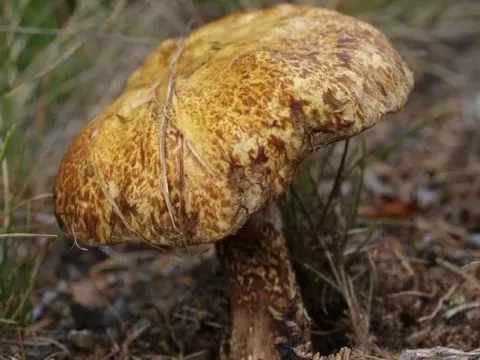
Siberian larch bolete
Suillus sibiricus
The Siberian larch bolete (Suillus sibiricus) is not a plant disease agent but a symbiotic basidiomycete fungus. It is an essential component of the forest ecosystem, forming mycorrhizal associations with various pine species.
What the section contains
Siberian larch bolete
This fungus creates a mutually beneficial relationship with its host trees, known as ectomycorrhiza. The mycelium extends the root surface area, allowing the tree to absorb more water and nutrients from the soil.
Labeling this fungus as a disease is biologically inaccurate. It does not cause tissue degradation, necrosis, or root rot, which are hallmarks of true plant pathogens.
The fungus is highly specialized to coexist with five-needle pines, showing no pathogenic behavior during its entire life cycle.
In forest management, Suillus sibiricus is viewed as a beneficial organism that supports seedling establishment and growth in nutrient-poor forest soils.
The development of Suillus sibiricus is strictly tied to the presence of host conifers, primarily Pinus sibirica and related species. It requires acidic soils rich in organic matter to thrive.
High soil moisture and moderate temperatures are the key environmental factors that trigger the growth of the fungal mycelium and the production of fruiting bodies.
The spores are dispersed by wind, insects, and small mammals, allowing the fungus to colonize vast forest areas where host trees are present.
Soil aeration and pH levels significantly influence the density of the mycelial network around the root zones of the trees.
In nurseries, the presence of these fungi is often encouraged to enhance the survival rate of young pine saplings before their outplanting.
There is no evidence of harm caused by the Siberian larch bolete. It does not negatively impact the health, vigor, or longevity of the trees it associates with.
The misidentification of this fungus as a pathogen can lead to the inappropriate application of chemicals, which may disrupt the forest ecosystem.
No economic damage to the forestry sector is attributed to this species, as it contributes to the overall stability and health of the forest.
Unlike parasitic fungi that extract energy from the host, this bolete contributes to the energy balance of the plant through its nutrient-sharing function.
Therefore, it poses no risk to forest productivity or the quality of timber production.
No protective or control measures are required, as Suillus sibiricus is not a harmful agent. Managing forests to eradicate it would be ecologically unsound.
If its presence is undesirable in specific ornamental settings, manual removal of the mushrooms is sufficient to minimize spore spread.
Controlling moisture levels can limit the frequency and density of fruiting body formation if necessary for land management purposes.
Integrated pest management protocols should avoid the use of systemic fungicides in areas where beneficial mycorrhizal fungi are present to support tree health.
The best practice is to maintain a natural forest balance, where such symbionts are allowed to fulfill their role in soil nutrient cycling.