
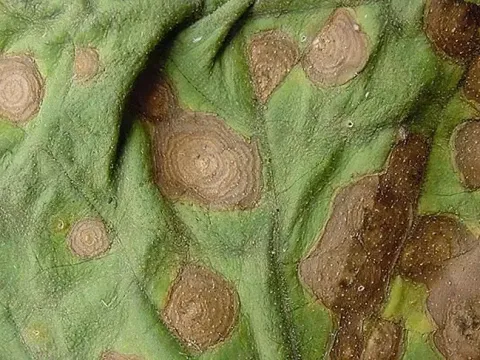
Corynespora leaf spot
Corynespora torulosa
The causal agent of Corynespora leaf spot is the imperfect fungus Corynespora torulosa, which belongs to the class of Hyphomycetes. This pathogen can persist in soil and plant debris in the form of mycelium, conidia, or chlamydospores, ensuring its high survival rate in adverse conditions.
What the section contains
Corynespora leaf spot
The life cycle of the fungus includes active asexual reproduction via conidia, which are dispersed by wind, raindrops, or agricultural activities. The pathogen possesses high enzymatic activity, enabling it to degrade host cell walls efficiently.
Optimal conditions for pathogen development are high relative humidity and moderately warm temperatures. Under high tropical humidity, the fungus displays maximum virulence, making it a significant threat to many tropical and subtropical crops.
The fungus infects leaf tissues, causing necrosis and premature death. In addition to direct leaf infection, Corynespora torulosa can invade fruits and stems, complicating disease control efforts within a plantation.
The biological specificity of the pathogen allows it to parasitize living tissues while also persisting saprotrophically on organic debris. This feature complicates the use of crop rotation as the sole method for eradicating the infection from the field.
The primary symptom of infection is the appearance of irregularly shaped spots, which enlarge and coalesce as the disease progresses. Initially, the spots appear chlorotic, later turning brown or dark gray.
A hallmark symptom is the formation of concentric zones within the spots, giving them a characteristic «target» appearance. The center of these spots often shows a necrotic area with a grayish fungal growth composed of conidiophores and conidia.
When fruit is affected, sunken, circular spots appear and gradually expand. Such fruit loses commercial quality and is often prone to secondary rotting due to the invasion of other microorganisms.
Stem infections can manifest as dark longitudinal streaks or lesions, which disrupt the plant's vascular flow. Severe stem infection leads to deformity and premature wilting of the plant's vegetative parts.
Affected plants exhibit premature yellowing and leaf drop, starting from the lower canopy. This leads to a significant decrease in photosynthetic activity and, consequently, a sharp decline in overall crop productivity.
The main factor promoting the development of Corynespora leaf spot is high atmospheric humidity above 80-85%. Prolonged leaf wetness following rain or irrigation significantly accelerates the germination of fungal spores.
Temperature ranges of 25–30 degrees Celsius are considered most favorable for the rapid spread of the fungus. However, the pathogen remains active at lower temperatures as long as high humidity levels persist.
Dense plantings and poor ventilation in greenhouses create a microclimate ideal for the buildup of inoculum. Poor air circulation prevents the rapid drying of leaf surfaces after exposure to moisture.
Violation of agricultural practices, particularly excessive nitrogen fertilization, promotes the formation of lush vegetative growth. Such tissues become more susceptible to fungal mycelium penetration due to the loose cellular structure.
Failure to timely remove crop debris serves as a primary source of infection for the new season. Fungal spores can maintain viability in the soil at depths of up to 15-20 cm for several years.
The harm caused by Corynespora leaf spot lies in the drastic reduction of the leaf's assimilatory surface area. This leads to yield loss and reduced nutrient accumulation in the harvestable parts of the plants.
Infection of fruits makes the produce unsuitable for sale or long-term storage. Even minor spots on the surface of the peel can lead to deep-seated rot during the transportation and distribution process.
The disease causes mass shedding of blossoms and young fruit, which critically lowers yield figures. In fruit and vegetable crops, this manifests as premature fruit drop during early developmental stages.
The disease negatively impacts seed viability if the pathogen infects reproductive organs. Seeds harvested from infected plants can carry hidden infections, spreading the disease to new geographical areas.
Economic losses arise not only from reduced yields but also from significant expenditure on fungicide applications. The need for regular spraying increases production costs and complicates the pursuit of sustainable, residue-free farming.
The first step in management is the use of healthy, disease-free planting material. Pre-sowing seed treatment with systemic fungicides can reduce the risk of infection during the early growth stages.
Strict adherence to crop rotation is necessary, avoiding the return of susceptible crops to the same field for at least 3-4 years. Strategic crop sequencing helps to naturally decrease the pathogen load in the soil.
Cultural practices include deep plowing or complete removal of plant debris after harvest. Eliminating weeds, which may serve as alternative hosts, is also critical for field protection.
Upon detection of initial disease symptoms, the application of chemical plant protection products is recommended. Fungicides based on triazoles, strobilurins, and copper compounds are effective when applied according to regulatory guidelines.
Optimizing irrigation management and switching to drip irrigation instead of overhead watering helps avoid prolonged leaf surface moisture. Ensuring proper ventilation in greenhouses is a mandatory requirement for preventing disease outbreaks.