
Coryneum blight
Coryneum megaspermum
The causative agent of the disease is a microscopic imperfect fungus, Coryneum megaspermum. It belongs to the class of Deuteromycetes and specializes in attacking woody plants and shrubs.
What the section contains
Coryneum blight
The pathogen's life cycle involves the formation of conidial sporulation, which serves as the primary source of infection spread during the growing season. The fungus survives in plant debris and affected bark tissues as mycelium.
The pathogen exhibits high adaptability, allowing it to overwinter in bark crevices and deep cankers on branches. In spring, as favorable conditions arise, fungal spores are actively spread by wind, rain splashes, and insects.
The biology of Coryneum megaspermum involves infecting tissues through natural openings or mechanical injuries to the bark. Once inside, the fungus begins intensive growth, destroying plant cells.
Mycological studies confirm that this species is a specific aggressor capable of rapidly colonizing weakened or frost-damaged plants in garden settings.
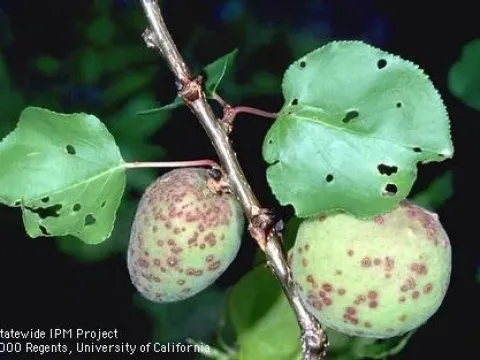
The primary sign of the disease is the appearance of characteristic spots on leaves, shoots, and bark. The spots are often brown or reddish-brown with a distinct dark border.
Cankers form on the affected bark areas, which can eventually merge and girdle the branch. This leads to the gradual dieback of individual skeletal branches or the entire tree.
Under high humidity, the fungus's sporulation appears on the surface of affected areas. It looks like small dark bumps, which may have a shiny sheen upon close inspection.
Leaves on infected trees begin to yellow and fall prematurely. The process is accompanied by deformation of the leaf blade in areas where fungal colonies are located.
In cases of fruit infection, sunken spots with a characteristic coating may appear. The quality of the harvest is significantly reduced, making the produce unsuitable for storage.
The development of Coryneum blight depends directly on air humidity levels. Prolonged rains and frequent fogs create an ideal environment for spore germination.
The optimal temperature range for the pathogen's development is moderate. A cool and damp spring significantly accelerates initial invasion.
Poor agricultural practices, particularly overcrowding of plantings, contribute to air stagnation. In such conditions, the fungus spreads faster within the canopy of a single tree and moves to neighboring ones.
Weakening of trees due to unfavorable winter conditions (frost damage) facilitates infection. Tissues with a low immune status cannot effectively resist mycelial penetration.
Accumulation of the infectious background is promoted by plant debris left under trees in autumn. Uncleaned fallen leaves serve as the main reservoir of spores for the next season.
The main danger of Coryneum blight lies in the gradual drying of branches. Without proper control, the disease can lead to the total loss of the garden's decorative and productive value.
Infection of the cambium and vascular system hinders normal sap flow. This weakens the plant's immunity, making it vulnerable to secondary pests and other diseases.
Economic damage manifests not only in reduced harvest weight but also in the death of young saplings. Diseased trees become a source of infection for the entire plot.
Prolonged bark infection leads to extensive necrosis that cannot be treated. Eventually, such trees must be removed and disposed of.
Reduced photosynthetic activity of leaves leads to a lack of sugar accumulation in fruits. As a result, fruits lose their taste and marketability.
- Perform annual sanitary pruning, removing all affected branches.
- Mandatory disinfection of pruning cuts with grafting wax or copper-based pastes.
- Collection and burning of fallen leaves in autumn to reduce spore concentration.
- Use of copper-based fungicides for preventive spraying of trees in early spring.
- Maintenance of optimal planting distances to improve air circulation within the canopy.