
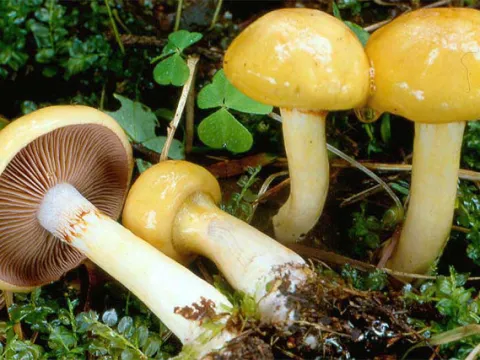
Yellow Webcap
Cortinarius delibutus
The Yellow Webcap (Cortinarius delibutus) is not a plant disease or a pathogen. It is a basidiomycete fungus that typically establishes a symbiotic relationship with forest trees through ectomycorrhizae.
What the section contains
Yellow Webcap
Instead of attacking plants, this fungus acts as a partner to trees, assisting in the uptake of nutrients and water from the soil. It is a completely beneficial component of forest soils and is never considered a pest.
In agronomy and plant pathology, the species is classified as harmless to agricultural crops and forest plants. It does not cause wilting, necrosis, or structural decay in wood or plant tissues.
The fungus is strictly a biological organism that participates in the nutrient cycle. It thrives on decaying leaf litter while remaining connected to live tree roots for mutual benefits.
Because it is not a pathogen, there is no need for chemical protection, fungicides, or phytosanitary control. Its presence indicates a stable and healthy forest environment.
The most distinctive feature of the Yellow Webcap is the thick, sticky layer of slime that covers its cap. This gelatinous coating helps prevent the fungus from drying out.
The cap typically displays shades of yellow, ochre, or pale orange. The stem is also often yellow and can appear somewhat sticky due to the remains of the universal veil.
The gills underneath the cap are initially covered by a cobweb-like structure known as the cortina. As the fungus matures, this veil breaks, leaving delicate remnants on the stem.
The fungus is usually spotted growing on the ground in moist woodland areas. Its appearance is seasonal, typically coinciding with late summer and autumn rainfall.
- Heavy slime on the cap surface
- Yellow to ochre color palette
- Presence of a cortina (cobweb-like veil)
- Mycorrhizal association with host trees
Cortinarius delibutus requires high soil moisture and moderate temperatures to produce fruit bodies. It is commonly found in damp areas within deciduous and mixed woodlands.
The primary prerequisite for its growth is the presence of suitable host trees, particularly birch and other hardwoods, with which it forms essential symbiotic mycorrhizal bonds.
The soil environment must be rich in organic matter and leaf litter, which provides a substrate for the fungal mycelium to thrive and expand within the upper soil layers.
Environmental stability is crucial, as the fungus is susceptible to soil disturbance and extreme fluctuations in humidity. It prefers shaded areas protected from direct sun.
Heavy usage of chemical agents or extreme compaction of the forest soil can disrupt the fungal network and lead to a significant decline in the population of this species.
As this species is not a disease, no control or preventative measures are required. It serves an ecological purpose and should be preserved as part of the natural forest flora.
Management efforts should focus on maintaining the health of forest ecosystems. Avoiding the use of systemic fungicides in areas where mycorrhizal fungi are present is highly recommended.
Protection of the root systems of host trees and maintaining proper soil structure are the best ways to support the natural diversity of fungi including the Yellow Webcap.
No agricultural regulations apply to this organism as it poses no threat to crops, pastures, or ornamental gardens. It is a natural biological element of forest ecosystems.
If you encounter this fungus, recognize it as a sign of biological richness and the active presence of symbiotic processes beneath the forest floor.