
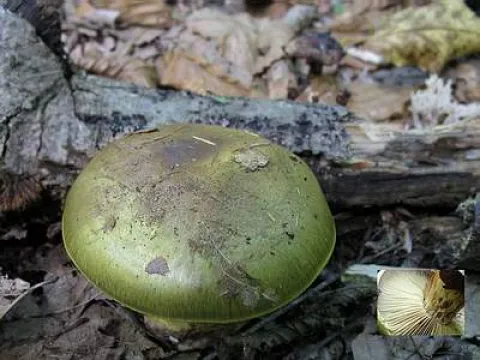
Cortinarius atrovirens
Cortinarius atrovirens
Cortinarius atrovirens is not a plant pathogen and does not cause agricultural diseases. It is a fungal species belonging to the family Cortinariaceae, widely found in forest ecosystems.
What the section contains
Cortinarius atrovirens
This mushroom functions primarily as a mycorrhizal partner, creating symbiotic relationships with the roots of coniferous trees, which is beneficial for forest tree health rather than harmful.
In agronomy, it is never classified as a disease or pest, as it lacks the enzymatic machinery to degrade living plant tissue in crops.
Its mycelium develops exclusively in the soil and leaf litter layer, contributing to organic matter decomposition rather than interfering with cultivated plant growth.
Labeling this organism as a crop disease is biologically incorrect; it is a saprotrophic and mycorrhizal fungus of no significance to plant pathology.
The fruit body of this species is characterized by its distinct yellowish-green to olive color, which matures into a dark, greenish-black tone.
Young specimens display a characteristic cortina, a spiderweb-like veil that covers the gills, connecting the cap margin to the stem.
The gills are typically olive-colored, turning rusty-brown as the spores mature and are dispersed into the surrounding environment.
The surface of the cap is often fibrillose or slightly scaly, providing a unique appearance that distinguishes it from other cortinarius species.
Physical evidence of its presence is limited to the fruit bodies emerging from the soil in coniferous forests during favorable moisture conditions.
Development is heavily dependent on specific climatic conditions, particularly high humidity levels combined with cool temperatures in late summer and early autumn.
The presence of suitable host trees (conifers) is essential for the fungal mycelium to complete its life cycle through mycorrhizal associations.
The fungus thrives in undisturbed environments with acidic soil, which is common in mature pine or spruce forests.
Optimal growth occurs in shaded areas where soil moisture remains constant, avoiding direct exposure to drying winds or high solar radiation.
Biological success of the fungus depends on the integrity of the soil microbial community and the absence of soil contamination.
The species poses no threat to agricultural productivity, horticulture, or field crop development.
Because it is not a pathogen, there is no economic damage associated with Cortinarius atrovirens in agricultural practice.
It does not infect or colonize any commercial plant species, and therefore no control measures or prevention strategies are required.
Potential risk is associated solely with human health, as many mushrooms in the Cortinarius genus are known to be toxic if consumed.
In conclusion, this organism is considered harmless to crops and should be recognized as a natural component of temperate forest landscapes.