
Coenogonium
Coenogonium
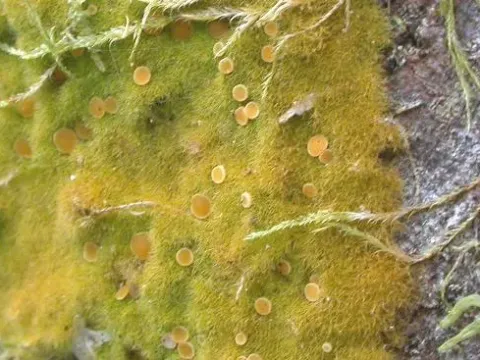
Coenogonium manifests as specific growths on the bark surface, often appearing as thin, branching filaments or small patches with a greenish or grayish hue.
What the section contains
Coenogonium
Unlike many parasitic fungi, Coenogonium is a lichen that uses tree bark exclusively as a substrate for anchoring its thallus.
Upon close inspection, one can notice that the colonies of this lichen adhere tightly to the bark, sometimes creating a velvety or felt-like coating that can expand over time.
Visually, the infestation resembles moss layers or algal colonies, but the structure of Coenogonium is more organized and specific to this genus of organisms.
With severe growth, the lichen can completely cover tree branches, obscuring the natural color and texture of the bark, which complicates monitoring the plant's overall health.
The agent responsible for this condition is the lichen genus Coenogonium, which is a symbiotic organism consisting of a fungal mycobiont and an algal photobiont.
These organisms are not true plant pathogens in the classical sense, as they do not penetrate into the plant's internal tissues or feed on its sap.
The biological role of the lichen is to use the tree bark as a support for accessing sunlight and atmospheric moisture in high-humidity conditions.
Reproduction of Coenogonium occurs primarily through vegetative means or via spores, which are dispersed by wind and water, anchoring on suitable rough surfaces.
Since the photosynthesis process is provided by the algal component, the lichen can exist for a long time, gradually increasing its coverage area on the tree.
The development and active spread of Coenogonium depend directly on microclimatic conditions in a garden or forest area.
A key factor is a high level of air humidity, which is necessary for the lichen's metabolism and keeping it in an active state.
Dense planting and a lack of regular crown pruning create stagnant zones where moisture is retained longer, promoting bark colonization.
Also, old trees with rough, cracked bark serve as an ideal anchor for spores, providing a favorable environment for the lichen to establish itself.
Insufficient ventilation and shading of areas further stimulate the growth of epiphytic organisms on trunks and skeletal branches.
The main danger of Coenogonium is its role in creating a favorable environment for the reproduction of various pests that hide under the layer of lichen.
A dense layer of lichen can hinder the normal gas exchange of the tree bark, which in the long term negatively affects the plant's physiology.
The presence of large lichen colonies often indicates an oppressed state of the tree, which may have arisen due to improper agricultural practices.
Damaged or old bark under the lichen layer dries out poorly, which triggers the development of secondary fungal and bacterial infections.
The aesthetic degradation of trees in ornamental gardens and park zones reduces the overall attractiveness of plantings, requiring additional sanitation measures.
The primary measure of protection is performing regular sanitary and formative crown pruning to improve air circulation around the tree.
Mechanical cleaning of the bark using scrapers or stiff brushes allows for the effective removal of lichen colonies without damaging living cambium tissues.
The application of a lime solution or specialized copper-based preparations helps create an environment unsuitable for the development of lichen colonies.
- Regular whitewashing of trunks with lime mixed with copper sulfate.
- Normalization of moisture levels by thinning out tree crowns.
- Timely removal of dead bark sections.
Prevention includes maintaining tree health through balanced fertilization and watering, which strengthens the protective functions of the bark.