
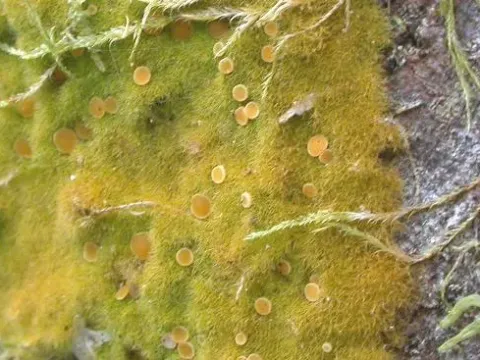
Coenogoniaceae
Coenogoniaceae
The external signs of Coenogoniaceae lichens appear as specific coatings or thin, thread-like and crustose formations on the surface of tree bark.
What the section contains
Coenogoniaceae
Unlike parasitic fungi, these lichens exhibit a characteristic color ranging from bright green to grayish-green, caused by the presence of algae within their thallus.
On affected areas, the bark may appear rougher, and active growth spots often show a thickening that resembles a fuzzy or velvety coating.
Lichens are frequently localized on older branches or trunks, where the bark renewal process is slower, providing a stable base for attachment.
Under close inspection with a magnifying glass, one can identify small fruit bodies known as apothecia, which serve as the reproductive organs of the lichen.
The pathogens are members of the Coenogoniaceae family, which are symbiotic organisms consisting of a mycobiont (fungus) and a photobiont (green algae).
These organisms are not true pathogens in the classic sense, as they do not feed on the plant's sap but use the bark strictly as a substrate for attachment.
The interaction is classified as epiphytic; however, massive growth can interfere with bark gas exchange and create a habitat for various pests.
The biological complexity of the lichen lies in its slow growth rate and absolute dependence on external environmental factors like humidity and air quality.
Their presence is a diagnostic indicator of poor horticultural practices or general stress in the tree, requiring professional assessment.
The primary condition for colonization is high atmospheric humidity, which persists in dense tree canopies with poor ventilation.
Lichen development is favored by stagnant moisture on the bark surface, caused by the lack of proper pruning and canopy management.
These organisms prefer shaded parts of the orchard, where direct sunlight does not dry out the bark during the day, maintaining a consistently moist environment.
The absence of regular sanitary measures and the presence of damaged bark provide perfect micro-cracks for the initial fixation of lichen spores.
The age of the orchard is also a risk factor, as old trees with deep bark fissures are more susceptible to colonization than young, healthy saplings.
Lichens do not exert direct toxic effects on the plant, but they create a physical barrier that restricts the normal respiration of bark tissues.
Massive coverage of the trunk hinders moisture evaporation and can lead to bark overheating during summer, causing localized physiological damage.
Under the lichen layer, a microclimate is created that is perfect for the overwintering of pests, such as scales, mites, and spores of pathogenic fungi.
The presence of lichens often signals poor sap flow or general tree suppression, which reduces overall productivity and immunity to infections.
In neglected cases, the aesthetic value of the tree declines, and the canopy becomes less productive due to the impairment of metabolic processes.
The primary control measure is regular mechanical cleaning of trunks and main branches using scrapers or stiff brushes during the dormant period.
Conducting annual sanitary pruning helps improve light penetration and canopy aeration, creating an environment unsuitable for lichen growth.
Applying lime wash with copper sulfate to the trunks is an effective method, as it creates an alkaline environment that suppresses lichen expansion.
Spring applications of copper-based fungicides can eliminate young lichen colonies before they establish a firm foothold on the bark.
To improve orchard health, it is recommended to optimize overall horticultural practices, including fertilization and watering, to stimulate natural bark renewal.