
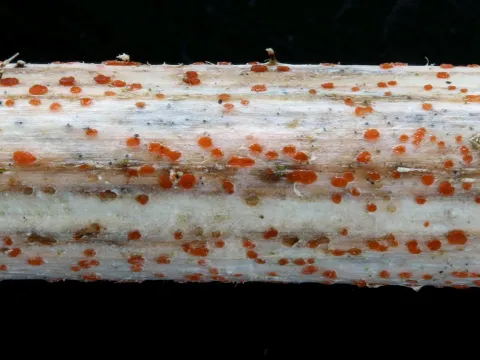
Clavaria incarnata
Clavaria incarnata
The causative agent of the disease is the fungus Clavaria incarnata, belonging to the Clavariaceae family. In an agronomic context, it acts as a weak parasite that can colonize tissues of weakened plants under specific environmental conditions.
What the section contains
Clavaria incarnata
The mycological nature of the pathogen is characterized by the formation of club-shaped fruit bodies with a pale pink or flesh-colored hue. Reproduction occurs through spores, which are disseminated by wind, water, or farm machinery across susceptible substrates.
The pathogen favors moist plant residues but can migrate to living tissues under high infection pressure. The biological activity of the fungus is strictly tied to the presence of organic matter in the soil or on the plant surface, serving as a primary nutrient source.
The life cycle includes a dormant stage as mycelium, which can survive in unfavorable conditions for long periods. Once optimal temperature levels are met, the fungus activates and develops visible sporulation structures.
Genetic adaptation allows this fungus to compete with other soil microorganisms, complicating infection control in dense agricultural ecosystems. Continuous monitoring is required to manage the spread of the pathogen throughout the growing season.
The primary symptom is the appearance of characteristic pink growths or thin thread-like structures on the stems and root collars of plants. These are the fruit bodies of the fungus, easily identifiable during inspections of the lower plant layers.
At sites of mycelial development, plant tissues darken and gradually soften. Eventually, the affected areas lose mechanical integrity, leading to lodging or stem breakage in the infected zone.
The process is often accompanied by an unpleasant decaying odor, indicating secondary bacterial infection associated with fungal activity. Plants in affected patches show stunted growth and characteristic leaf chlorosis.
A felt-like coating can be observed at the root collar, signaling active development of Clavaria incarnata. In high-humidity conditions, the surface of the affected plant parts becomes slimy.
- Formation of pink club-shaped growths
- Softening and decay of stem tissues
- Stunted growth and chlorosis
- Mycelial felt-like coating on the root collar
Excessive soil and air humidity is the main factor promoting disease outbreaks. Relative humidity above 85% creates an ideal environment for spore germination and active fruit body formation.
The temperature optimum for the fungus ranges from +15 to +22 degrees Celsius. Under these conditions, the mycelium spreads rapidly, covering large areas of the field in a short time frame.
The presence of significant undecomposed plant residues on the soil surface provides an ideal substrate for primary infection. Stubble from previous seasons often acts as a reservoir for the fungus to spread to young seedlings.
Lack of crop rotation and continuous monoculture significantly increase the risk of epiphytotic spread. Dense, poorly ventilated crop stands create a microclimate that traps moisture and favors infection.
Plant stress due to micronutrient deficiency is also a critical factor. Strong and healthy plants exhibit much higher resistance to the invasion of this pathogen compared to stressed crops.
The damage caused by Clavaria incarnata involves direct injury to the vascular system, disrupting the transport of water and nutrients. This leads to a decline in photosynthetic intensity and overall crop productivity.
Infection of the root zone often leads to plant death, resulting in thin stands and substantial yield losses. In favorable conditions, up to 40% of the field area may be affected.
Injured plants become highly susceptible to other pathogens, including Fusarium and Pythium species. This creates a complex disease scenario that makes diagnosis and treatment more difficult.
Yield quality decreases as well. Grains or fruits from infected plants often have low mass and poor germination energy, negatively impacting seed quality for the next season.
Beyond direct economic loss, infested fields require additional expenses for sanitation and fungicide applications. The long-term presence of the pathogen in the soil limits future crop choices.
Preventive measures focus on crop rotation, avoiding susceptible crops on the same field for consecutive years. This disrupts the pathogen's development cycle and lowers soil inoculum levels.
Deep plowing with thorough incorporation of crop residues promotes organic decomposition and suppresses mycelial growth. The use of certified, treated seeds is essential to prevent initial infection.
Managing crop density and balanced fertilizer application enhance plant immunity. Avoiding excessive irrigation during active growth phases helps reduce the probability of disease development.
Chemical control involves the application of systemic fungicides effective against Basidiomycota. Treatments should be applied at the first sign of symptoms to prevent mass spore dispersal.
Biological control using Trichoderma-based products can help suppress Clavaria incarnata in the soil. An integrated protection system combining cultural and chemical methods provides the best long-term results.