
Clavaria zollingeri
Clavaria zollingeri
Description
Symptoms
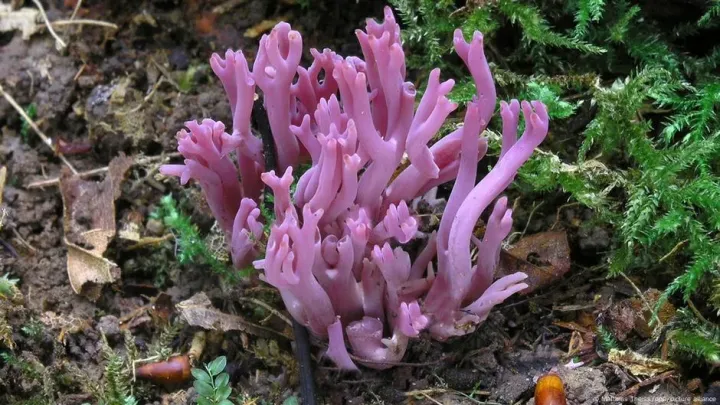
Clavaria zollingeri, commonly known as the violet coral fungus, is recognized by its unique branching fruit body that resembles coral structures. The color ranges from vivid violet to deep purple, making it highly distinct.
The fruit bodies typically stand between 5 and 10 centimeters tall. The branches are often brittle and may have rounded or toothed tips, adding to their intricate and delicate appearance in forest litter.
It is critical to distinguish this organism from plant pathogens. Clavaria zollingeri does not produce lesions, wilting, or rotting symptoms on living plant tissues or crops.
The intensity of the color can fluctuate based on environmental moisture and sunlight exposure. Young specimens usually display the most vibrant purple pigmentation.
Unlike many other fungi, it lacks a defined stipe, as the branches arise directly from the base, which is anchored in nutrient-rich soil or decaying organic matter.
Pathogen
From an agronomic perspective, Clavaria zollingeri is not a plant disease. It is a saprotrophic fungus that plays a vital role in decomposing organic material within soil ecosystems.
Belonging to the Basidiomycota division, this fungus feeds on non-living organic matter, facilitating the recycling of nutrients. It does not possess the enzymatic capacity to infect or parasitize living vascular plants.
Labeling this species as a disease-causing agent is a misconception. Its presence in an environment is a sign of a healthy, organic-rich soil rather than a sign of agricultural pest pressure.
The species does not have any host range among agricultural crops, as it has no evolutionary requirement to feed on living cellular tissue. It is strictly a decomposer.
In modern agricultural science, this species is categorized as a beneficial component of the soil mycobiota, contributing to long-term soil structure and fertility.
Conditions for development
The development of Clavaria zollingeri requires specific environmental conditions, primarily high humidity and stable, undisturbed habitats rich in organic mulch or leaf litter.
This species is highly sensitive to soil disturbance and chemical interventions. It is rarely found in intensely managed agricultural fields due to the constant tillage and pesticide application.
The thermal optimum for the emergence of its fruit bodies occurs in late summer or autumn, coinciding with periods of high rainfall and cool to moderate temperatures.
Optimal growth requires shaded environments, protected from extreme direct sunlight and desiccation. It thrives where the soil pH remains relatively stable and acidic, characteristic of forest floors.
The presence of this fungus serves as a bioindicator of an ecological site that has not been significantly altered by heavy industrial farming practices or chemical pollution.
Why it matters
Clavaria zollingeri poses no risk or economic threat to agricultural or horticultural production. It is not harmful to crops and does not require any form of plant protection control.
There are no recorded instances of this species causing damage to harvests, root systems, or vegetative growth. It lacks the mechanisms required to breach plant immunity.
In agricultural settings, no monitoring for this fungus is needed. Its existence is entirely benign and is part of the natural biological cycle of nutrient turnover.
Applying fungicides to control this species is considered bad practice, as it indiscriminately damages beneficial soil organisms that support plant health and soil sustainability.
The species is considered a part of the natural biodiversity and is often protected in many regions; it should not be viewed as a target for eradication.
Protection
No protective or control measures are necessary for Clavaria zollingeri. Since it is not a pathogen, there is no agronomic justification for its removal.
If its appearance on a managed property is aesthetically undesirable, simply reducing organic mulch layers or improving drainage will naturally discourage its growth by reducing moisture.
Chemical control is strongly advised against, as it can harm the complex balance of soil microbiota, which is essential for healthy plant development and long-term soil productivity.
Preventing its growth in specific areas can be achieved by regular soil aeration and reducing the accumulation of decaying leaf litter, which denies the fungus its primary energy source.
Maintaining a healthy, well-drained garden or field is the best way to ensure that any fungal growth remains balanced and non-problematic within the existing ecosystem.
Discussion
No discussions yet — be the first.