
Dollar spot
Clarireedia monteithiana
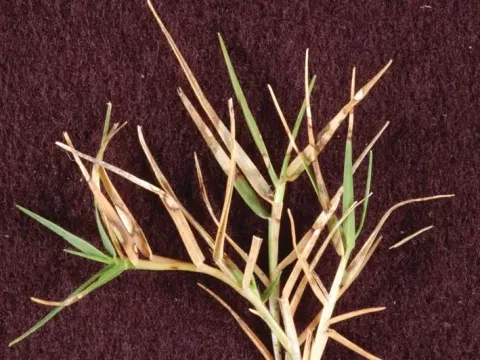
Dollar spot is characterized by the appearance of small, circular, sunken spots about 2–5 cm in diameter, which resemble the size of a silver dollar. On close inspection, the grass blades within these spots turn yellow and then bleach to a straw-white or tan color.
What the section contains
Dollar spot
A hallmark symptom is the presence of hourglass-shaped lesions on individual leaf blades, which are light tan in color and bordered by a reddish-brown band. In the early morning, especially under high humidity, a white, cobweb-like mycelium may be visible covering the affected areas.
On closely mowed turf, such as golf putting greens, the spots remain small and distinct. In contrast, on taller lawn grass, these spots may coalesce to form large, irregular, blighted patches that significantly detract from the appearance of the lawn.
The disease primarily attacks the leaf tissues, leaving the root system largely unaffected in the early stages. However, as the leaves die, the turf density decreases, leading to bare patches that allow weeds to invade.
The mycelium often disappears as the day warms up and the dew evaporates, but the pathogen remains active within the plant tissues, waiting for the next period of high humidity to resume its outward growth.
The causative agent of this disease is a fungus scientifically known as Clarireedia monteithiana. It was formerly classified as Sclerotinia homoeocarpa and is one of the most widespread turfgrass pathogens worldwide.
The fungus survives as dormant mycelium within infected turfgrass and thatch. It does not produce sclerotia, instead spreading through the growth of its mycelium or through wind and water dispersal of fragmented fungal strands.
Mechanical spread is a significant factor in the distribution of the disease, as lawn mowers, shoes, and maintenance equipment can easily carry the fungus from infected areas to healthy patches of grass.
Virtually all common turfgrass species, including Kentucky bluegrass and fescue, are susceptible to infection. The pathogen thrives particularly well when the host grass is under stress or experiencing slow growth.
Infection is initiated when the fungus comes into contact with wounded or susceptible leaf tissue. It secretes enzymes that break down the host cell walls, leading to rapid necrosis of the leaves and the formation of characteristic bleached spots.
Dollar spot development is heavily favored by prolonged periods of high humidity, such as heavy dews, frequent fogs, or light rainfall. It thrives in temperatures ranging from 15 to 30 degrees Celsius.
Nitrogen deficiency is a key environmental trigger for the disease. Lawns that are not adequately fertilized are significantly more susceptible to severe outbreaks than those with consistent nutritional programs.
Frequent, light irrigation keeps the leaf surfaces wet for extended periods, providing ideal conditions for the pathogen to thrive. Poor soil drainage and air circulation further exacerbate the spread of the fungus.
The disease is most prevalent during late spring, summer, and early autumn, when warm days are followed by cool nights, leading to high levels of leaf moisture accumulation overnight.
General stress factors, including drought, soil compaction, and dull mower blades that leave ragged, wounded leaf tips, increase the vulnerability of the turf to infection by Clarireedia monteithiana.
The primary harm caused by Dollar spot is the significant loss of turf aesthetics. The presence of numerous light-colored, dead spots destroys the uniformity and appeal of a well-maintained lawn.
If left uncontrolled, the fungus can kill large sections of grass, resulting in an open, thin canopy. This degradation provides an entry point for invasive weeds, which can permanently alter the lawn's botanical composition.
For sports and recreational turf, Dollar spot can severely impact playability by creating uneven surfaces that affect the ball roll and overall surface performance.
The disease cycle can repeat throughout the growing season, necessitating repeated chemical interventions and costly repair efforts, including overseeding and soil remediation.
Chronic Dollar spot infections weaken the overall vigor of the lawn, making it more prone to secondary infections and environmental stress, leading to a long-term decline in turf quality.
Proper nitrogen fertilization is the cornerstone of an effective management program. Ensuring the lawn has adequate nutrition helps the grass plants recover quickly from infection and minimizes the severity of outbreaks.
Watering practices should focus on infrequent, deep irrigation early in the morning. This allows the lawn to dry out during the day, reducing the duration of leaf wetness and discouraging fungal activity.
Cultural practices such as core aeration and dethatching are essential to improve drainage and air movement within the turf canopy. This helps lower the humidity at the soil and leaf surface interface.
Practicing strict sanitation is crucial; cleaning mowing equipment and tools after working in infested areas helps prevent the mechanical transfer of the pathogen to clean zones.
- Apply systemic fungicides such as those containing azoxystrobin or propiconazole.
- Rotate fungicide chemical classes to prevent the development of resistant fungal strains.
- Always follow label directions regarding dosage, timing, and environmental restrictions.
- Select and plant turfgrass cultivars that demonstrate resistance to Dollar spot disease.