
Cerrena fungi
Cerrenaceae
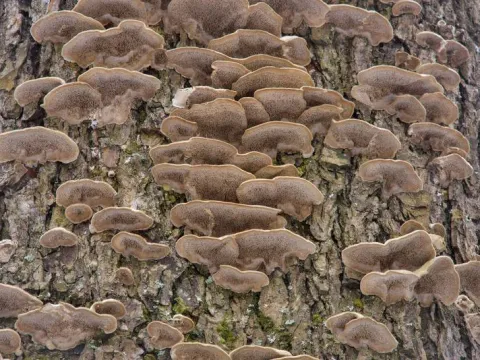
The symptoms of Cerrena fungi infection (family Cerrenaceae) primarily manifest on the trunks and branches of trees. The most distinct sign is the emergence of fruiting bodies, which typically appear as bracket-shaped or effused-reflexed structures.
What the section contains
Cerrena fungi
The color of these fruiting bodies ranges from whitish to yellowish or brownish, often with a fuzzy or hairy upper surface. The hymenophore (underside) is characterized by distinct teeth or labyrinthine pores, which serve as a primary identification feature for this group.
The internal wood tissue undergoes significant degradation, exhibiting signs of white rot. The wood becomes soft, loses structural integrity, and often splits along the grain, which leads to the weakening of the entire plant structure.
In advanced stages of the infection, mycelial mats can often be found under the bark, and the bark itself may crack or peel off. These areas serve as entry points for secondary pests that further exacerbate the tree's decline.
The infection is often accompanied by general crown dieback, reduced leaf size, and premature leaf drop, which indicates that the tree's vascular system has been compromised by the wood-decaying process.
The disease is caused by fungi belonging to the family Cerrenaceae (order Polyporales). These are wood-decaying organisms that specifically induce white rot in woody plant species.
These fungi act as facultative parasites or saprotrophs, capable of colonizing both weakened living trees and dead wood. Their mycelium penetrates deep into the tissue, secreting potent enzymes to digest the wood.
The main biological feature of this pathogen is its ability to enzymatically break down lignin and cellulose. This process provides nutrition for the fungus and causes irreversible destruction of the cell walls.
The fungus reproduces via basidiospores, which are dispersed by wind, water, or insects. Upon landing on damaged bark or pruning cuts, the spores germinate, establishing a new mycelial colony within the wood.
The life cycle of the fungus can span several years, during which new generations of fruiting bodies are continuously formed on the trunk, ensuring the persistent dispersal of the infection to the surrounding area.
Favorable conditions for the development of Cerrena fungi are found in areas with high humidity and limited airflow. Shaded locations within a canopy are particularly susceptible to the development of fruiting bodies.
Temperature plays a crucial role, as moderate warmth combined with consistent moisture stimulates active spore production. These environmental conditions are ideal for the rapid spread of the pathogen.
The physical health of the tree is a major factor in infection vulnerability. Mechanical wounds, frost cracks, sunscald, or poorly executed pruning cuts create ideal entry points for the pathogen to establish itself.
The presence of weakened or dying trees in the vicinity creates a high inoculum load. Nearby neglected orchards or forests with accumulated woody debris contribute significantly to the pathogen pressure on healthy trees.
A lack of proper maintenance, such as failure to remove dead branches or treat wounds, allows the fungus to create long-term reservoirs of infection that can persist for many years.
Cerrena fungi pose a significant threat to forestry and orchards due to their ability to rapidly compromise the structural integrity of trees. This represents a serious safety hazard in managed environments.
Trees affected by white rot become highly vulnerable to windthrow and limb breakage. The sudden collapse of large branches or entire trees can cause substantial property damage and economic loss.
The productivity of fruit trees declines sharply as the fungus blocks water and nutrient transport, leading to physiological exhaustion and eventually tree death.
The spread of the infection to nearby healthy specimens can necessitate large-scale removal of trees, significantly increasing the costs of garden or forest management.
Infected wood loses its technical quality, rendering it unsuitable for construction or high-value timber use, thereby reducing the market value of the harvested material.
The most effective management strategy is prevention. This includes the timely removal and destruction of infected trees, along with regular sanitary pruning to remove dead or diseased branches.
All pruning cuts and mechanical wounds must be promptly treated with disinfectants, such as wound paint or copper-based fungicides, to protect the exposed wood from spore colonization.
Maintaining high horticultural standards, including balanced fertilization and proper irrigation, enhances the tree's natural resistance to fungal pathogens.
If fruiting bodies are found on the trunk, they should be mechanically removed along with a layer of affected wood, followed by a thorough application of systemic fungicides to the wound.
- Regular inspection of trunks for the presence of fungal growths.
- Sterilization of pruning tools between uses to prevent cross-contamination.
- Maintaining proper spacing to ensure adequate ventilation.
- Disposing of infected wood debris through burning or deep burial.