
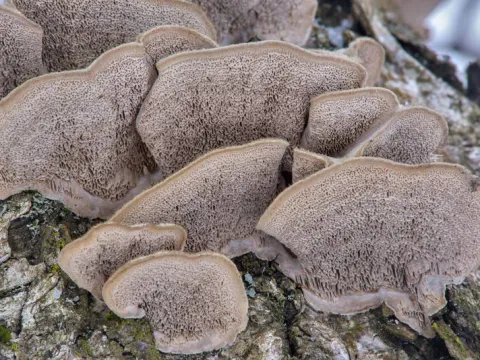
Cerrena albocinnamomea
Cerrena albocinnamomea
The fungus Cerrena albocinnamomea is a wood-decaying Basidiomycete known for its ability to degrade both living and dead woody tissues. It acts primarily as a parasite on weakened trees and a saprotroph on decaying logs.
What the section contains
Cerrena albocinnamomea
As a member of the bracket fungi group, it produces distinct fruiting bodies on the bark or wood surface. These structures house the spores used for dispersal throughout the forest ecosystem.
The mycelium of the fungus penetrates deep into the xylem, secreting powerful lignolytic enzymes that break down the complex structure of wood, eventually leading to its collapse.
Reproduction is facilitated by basidiospores that are carried by air currents. Once they land on a suitable substrate, such as a bark injury or a dead branch, they germinate and initiate new infection sites.
This fungus is biologically adapted to survive in various forest conditions, making it a persistent component of the decomposer community in many temperate regions.
The most visible sign of infection is the development of leathery or cork-like fruiting bodies. These sporocarps are typically white to brownish in color and often appear in clusters.
Internally, the wood undergoes a transformation known as white rot. As the fungus consumes lignin, the wood loses its structural integrity and becomes soft, fibrous, and pale in appearance.
External symptoms on a living tree include thinning of the canopy, premature yellowing of leaves, and a general decline in the tree's overall vigor and growth rate.
Under the bark, one might find white mycelial mats or cords, which are signs that the fungus has successfully established its colony within the host tree's cambium layer.
Late stages of infection show deep cracking, structural deformation of the trunk, and significant necrotic areas on the bark where the fungus has emerged to sporulate.
Cerrena albocinnamomea thrives in environments where host trees have sustained physical injuries from insects, storms, or human activities, as these wounds provide easy access.
High humidity levels and consistent moisture are essential for both spore germination and mycelial expansion. Therefore, dense, poorly ventilated stands are more susceptible.
Trees undergoing physiological stress—often caused by prolonged drought, soil compaction, or high concentrations of pollutants—show significantly higher infection rates.
A buildup of dead wood, such as fallen branches or old logs, provides a massive reservoir for the fungus, allowing it to build up high inoculum levels in the surrounding area.
Temperature fluctuations also play a role; moderate temperatures during the growing season typically support the most aggressive spread of the fungal infection.
The primary concern is the significant loss of timber value. Infected trees often develop internal cavities that make them useless for high-quality wood processing or construction.
The structural integrity of the tree is severely compromised by white rot, which increases the danger of windthrow and falling limbs, posing risks to public safety in parks.
In woodland ecosystems, a severe outbreak can lead to widespread tree mortality, causing gaps in the canopy and shifting the ecological balance of the forest habitat.
Furthermore, an infected tree is an easier target for secondary pests, such as bark beetles, which take advantage of the weakened condition to further damage the host.
Once established in a stand, the fungus can become endemic, requiring ongoing and expensive management to keep the damage within acceptable levels for forestry operations.
Sanitation is the most effective management strategy. Removing dead, dying, and diseased trees promptly helps eliminate the primary sources of fungal inoculum in the forest.
Care should be taken during silvicultural activities to minimize bark wounds, as these are the primary entry points for the fungus. If damage occurs, consider using protective sealants.
In ornamental and urban tree care, regular monitoring for fruit bodies is crucial. If found, the infected wood should be pruned and disposed of carefully, preferably by burning.
Maintaining tree vigor through proper fertilization, irrigation, and soil management can boost a tree's natural defense mechanisms against such fungal pathogens.
Establishing early detection systems through periodic forest health surveys allows for the rapid containment of small outbreaks before they spread throughout the entire stand.