
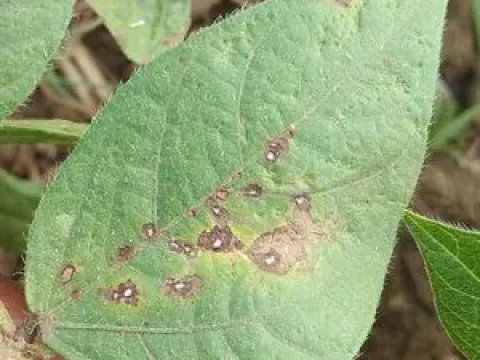
Cercospora leaf spot of legumes
Cercospora zonata
The causative agent of Cercospora leaf spot in legumes is the imperfect fungus Cercospora zonata, which belongs to the class Hyphomycetes. This pathogen specializes in attacking various species of the Fabaceae family, resulting in characteristic foliar symptoms.
What the section contains
Cercospora leaf spot of legumes
The fungal life cycle involves the production of conidia that are easily dispersed by wind, rain splashes, and insects. Throughout the growing season, the pathogen spreads rapidly, establishing new infection centers within the crop canopy.
The primary inoculum typically persists in infected crop residues left on the soil surface after harvest. The fungus remains viable in these residues as mycelia and conidia, serving as a reservoir for the next cropping cycle.
Pathogen hyphae penetrate plant tissues through stomata or physical wounds on the epidermis. Once inside, the fungus colonizes the intercellular spaces and secretes enzymes that degrade cellular structures.
Due to its high evolutionary plasticity, the pathogen adapts well to various microclimatic conditions. Frequent cycles of asexual reproduction ensure the disease remains present during the entire vegetation period.
Initial symptoms appear as small, chlorotic spots that eventually develop into brown or dark-colored lesions. A key diagnostic feature is the distinct zonation, which gives the lesion its characteristic appearance.
The spots are generally circular or angular, often delineated by leaf veins. As the disease progresses, a darker border forms around the central necrotic area, creating a classic target-like pattern on the leaves.
Under conditions of high humidity, a greyish or olive-brown mold develops on the underside of the leaves within the lesion area. This represents the fungal sporulation, consisting of conidiophores and conidia.
In severe cases, individual spots coalesce to cover large portions of the leaf blade. The affected tissues eventually turn yellow, wither, and drop prematurely, severely reducing the total photosynthetic capacity of the plant.
In addition to leaves, symptoms may also occur on stems, petioles, and pods. This systemic impact can lead to stunted growth and reduced seed quality, affecting both the yield quantity and the future crop potential.
The disease thrives in environments with high relative humidity, typically exceeding 70-80 percent. Frequent rain, heavy dew, and persistent morning fog provide the optimal conditions for spore germination and colonization.
Temperatures ranging from 20 to 25 degrees Celsius are considered optimal for the rapid development of Cercospora zonata. These conditions accelerate the incubation period and lead to widespread outbreaks.
Densely planted fields that lack adequate airflow often create a humid microclimate. This stagnant air traps moisture, making the crops highly susceptible to infection even when external weather is drier.
Poor crop rotation practices, such as planting legumes back-to-back in the same field, lead to the accumulation of high levels of inoculum in the soil, increasing the disease pressure over time.
Nutritional imbalances, particularly nitrogen excess combined with potassium and phosphorus deficiency, render plants more susceptible. Proper fertilization is essential for maintaining robust plant health and natural resistance.
The primary economic impact of Cercospora leaf spot is the significant reduction in leaf area. This loss of functional photosynthetic tissue prevents the plant from producing sufficient energy, leading to lower vegetative biomass.
The disease directly affects reproductive development, often causing seed abortion and shriveled pods. The resulting decrease in seed mass and overall yield significantly reduces the profitability of the crop.
Premature leaf senescence effectively shortens the plant's growth cycle. This lack of time for proper grain filling results in lower harvest quality and reduced market value for the final product.
Seed-borne infection is a critical concern, as seeds from diseased crops may have low germination rates and act as a carrier for the pathogen to new planting areas in the following year.
In epiphytotic years, yield losses can range from 15 to 30 percent or higher. Farmers often incur additional costs for fungicide applications to prevent these losses, impacting the overall return on investment.
A sound crop rotation strategy is the cornerstone of disease management, with a mandatory interval of 3–4 years between legume crops. This breaks the infection cycle and allows for the decomposition of infected residues.
Deep plowing of crop residues immediately after harvest is a vital practice. Burying the debris accelerates decomposition and reduces the amount of viable inoculum available for the next season.
The use of resistant or tolerant cultivars remains the most efficient and sustainable strategy for managing the disease, especially in areas where environmental conditions favor fungal growth.
- Planting certified, disease-free, and treated seeds.
- Timely application of systemic fungicides upon the appearance of early symptoms.
- Maintaining optimal row spacing to ensure adequate light and air circulation.
Effective weed management is also necessary to eliminate alternative hosts that may harbor the fungus during the off-season. Clean fields are significantly less prone to rapid disease progression.