
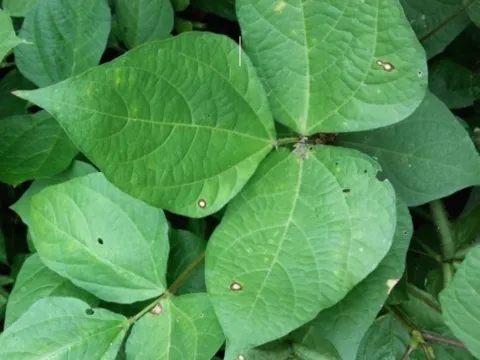
Cercospora leaf spot of legumes
Cercospora canescens
The disease is caused by the fungus Cercospora canescens, an imperfect fungus (Deuteromycetes) that serves as the primary pathogen for various legume crops.
What the section contains
Cercospora leaf spot of legumes
The pathogen survives between growing seasons on crop debris, in infested seeds, or in the soil, forming a reservoir for subsequent infections during the new season.
Reproduction occurs through the formation of conidia, which are disseminated by wind, splashing rain, and agricultural equipment throughout the canopy.
The fungus invades the leaf tissue, utilizing its enzymatic activity to degrade cell walls and absorb nutrients, which manifests as visible necrotic lesions.
The biological nature of this fungus allows it to persist in diverse environments, making it a persistent challenge for farmers in tropical and temperate regions.
Initial symptoms are characterized by small, scattered, circular to irregular lesions that are reddish-brown, tan, or gray in appearance.
As the disease progresses, the lesions expand and often develop a darker margin or a distinct halo, which helps differentiate it from other foliar diseases.
Under humid conditions, the center of the lesion may become covered in a grayish-olive velvety mold, consisting of the pathogen’s conidiophores and spores.
Severe infestations lead to the coalescing of spots, causing entire leaflets to yellow, wilt, and drop prematurely, resulting in defoliation.
On pods, the symptoms appear as depressed dark spots that can affect the quality and appearance of the harvested beans or seeds.
Cercospora leaf spot thrives in warm weather conditions, with the optimal temperature for pathogen development typically ranging between 20 °C and 28 °C.
High relative humidity and frequent rainfall are essential for the germination of conidia and the successful penetration of the fungus into the plant tissues.
Poor field management, such as planting at high densities, reduces airflow within the canopy, creating a micro-environment favorable for infection.
Prolonged leaf wetness duration, often caused by heavy morning dew or frequent fog, significantly increases the rate of disease spread in fields.
Stress conditions, such as nutrient deficiencies, can make host plants more susceptible to initial colonization by the fungal pathogen.
The primary damage caused by the disease is the reduction of the photosynthetic leaf area, which limits the energy available for grain and pod development.
Premature defoliation leads to a significant decrease in seed weight, quality, and total yield, often causing substantial economic losses for growers.
In addition to yield loss, the infection can lower the germination potential of seeds, posing a risk for future planting if infected seeds are used.
The disease weakens the overall vitality of the crop, making it more prone to secondary infections by other opportunistic pathogens and pests.
Marketability is often reduced due to the visible damage on the pods and the overall stunted appearance of the crop during a severe infestation.
Effective management begins with the use of disease-free, certified seeds and the implementation of a proper crop rotation cycle to break the life cycle of the fungus.
Cultural practices, including the deep plowing of crop residues, help to bury the inoculum and reduce the amount of pathogen present in the field.
Chemical control involving systemic fungicides is highly effective when applied at the onset of symptoms or based on environmental risk assessments.
Integrated Pest Management (IPM) strategies, which combine resistant varieties with timely fungicide applications, are the best approach for long-term control.
- Rotate legumes with non-host crops.
- Remove volunteer plants and weeds.
- Maintain proper plant spacing for aeration.
- Apply fungicides containing triazoles or strobilurins.