
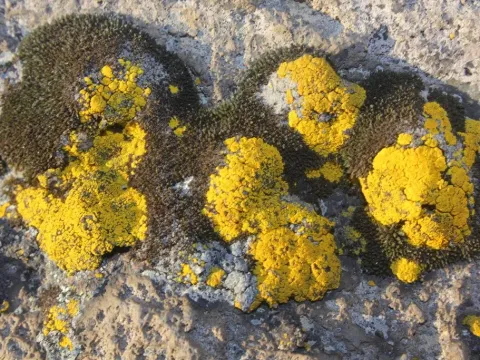
Candelariella lichens
Candelariaceae
Candelariaceae lichens, specifically of the genus Candelariella, appear as vibrant yellow, orange, or greenish-yellow crusts or tiny scales on tree bark.
What the section contains
Candelariella lichens
Initial colonization manifests as a fine, granular dusting that eventually expands into distinct rosette-like or crustose patches attached to the bark surface.
These lichens favor the mature, rough, and fissured bark of older trees, where they can find stable anchoring points for their development.
Unlike parasitic fungi, these organisms do not possess deep haustoria, meaning they reside strictly on the outer, dead layers of the cork tissue.
In cases of heavy infestation, the colonies may cover large portions of the trunk and branches, giving the tree a bright, dusted appearance that signals slow growth or environmental stability.
The organism is a symbiotic association (lichen) consisting of a fungal mycobiont and a green algal photobiont belonging to the Candelariaceae family.
These organisms are not true pathogens as they do not derive nutrients from the host tree, but their presence acts as a bioindicator of bark health.
The characteristic yellow pigment is produced as a protective mechanism against intense light and provides the organism with its distinct visual identity.
Reproduction is achieved through the dissemination of spores or vegetative thallus fragments, which are easily transported by wind or moisture to new sites.
They thrive in stable environmental conditions where the bark substrate remains relatively unchanged by rapid tree expansion or shedding.
High humidity and poor air circulation are the primary drivers for the colonization and expansion of these lichen species on tree bark.
Gardens with dense canopy coverage and limited sun exposure provide the specific microclimate necessary for sustained lichen growth.
Trees with slow-growing, static bark surfaces are more susceptible to colonization than young, vigorous trees that regularly shed their outer bark layers.
Environmental conditions that favor stagnant moisture on the bark surface significantly increase the probability of successful spore settlement.
Trees experiencing physiological stress or those in neglected orchards lack the self-cleaning capacity that would normally limit the growth of epiphytic communities.
While they are not direct parasites, the crusty growth of these lichens can physically impede gas exchange through the tree's lenticels.
The dense structure of the lichen thallus provides an ideal micro-habitat for various pests, including scale insects, mites, and aphid eggs, to overwinter safely.
Prolonged moisture retention beneath the lichen patches can lead to the softening of bark tissues, potentially predisposing the tree to secondary rot infections.
Although the damage is often aesthetic or indirect, an excessive lichen load is a strong diagnostic indicator of a tree's reduced physiological vigor.
In severe cases, the cumulative effect of reduced gas exchange and harboring of pests can contribute to the decline of the host tree's overall health.
Manual removal using soft brushes or plastic scrapers during damp weather is the safest method to clear lichens from the bark surface.
Application of horticultural washes, such as iron or copper sulfate solutions, is effective in eliminating established lichen colonies and their spores.
Improving air circulation through professional canopy thinning and pruning helps reduce the humidity levels that favor lichen survival.
Trunk painting with whitewash (lime-based mixtures) prevents the re-establishment of lichens by altering the bark surface chemistry.
- Maintain tree vigor through proper fertilization and watering.
- Regularly inspect the bark for signs of pest accumulation under lichen colonies.
- Promote good sanitation by removing severely colonized old branches.