
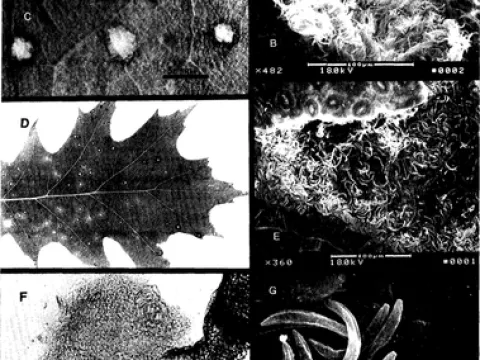
Candida cylindracea
Candida cylindracea
The causal agent of this plant disease is the yeast-like fungus Candida cylindracea. This microorganism functions as a facultative parasite, meaning it can exist as a harmless saprotroph in soil and organic debris, but becomes pathogenic when conditions are favorable.
What the section contains
Candida cylindracea
Biologically, the fungus is notable for its production of specialized extracellular enzymes, such as lipases and proteases. These enzymes allow the pathogen to effectively break down the cellular structure of host plants, facilitating its rapid colonization.
The organism reproduces through budding, which enables quick expansion across leaf surfaces and fruit tissue. It is a highly adaptable fungus, capable of surviving in various environments, from field soils to storage facilities.
As a member of the Ascomycota division, it forms colonies that often appear as white or creamy films on the surface of plant parts. While often secondary, it can quickly become a primary issue for crops with compromised physiological barriers.
Genetic plasticity allows the fungus to survive across a wide range of temperatures and pH levels, making it a persistent concern for farmers. Research highlights its role as both an independent pathogen and a contributor to decay complexes.
The development of Candida cylindracea is primarily driven by high relative humidity, typically exceeding 80–85%. Wet weather conditions, frequent morning dew, and fog provide the essential moisture required for spore germination.
The pathogen thrives in warm conditions, with an optimal temperature range of +20°C to +28°C. In such environments, the fungus can complete its reproductive cycles rapidly, leading to exponential growth of the infected area.
Physical damage caused by insects, hail, or mechanical harvesting creates entry points for the pathogen. Once it gains access to the nutrient-rich tissues inside the plant, colonization proceeds much more aggressively than on intact surfaces.
In greenhouses and closed systems, inadequate air circulation and high plant density are critical risk factors. These conditions trap moisture, fostering a stagnant microclimate that is perfect for fungal outbreak.
Over-fertilization with nitrogen can also promote succulent tissue growth, which is structurally weaker and more susceptible to penetration by fungal mycelium. Balancing soil nutrients is therefore key to managing the environment for the host plant.
The primary economic harm caused by Candida cylindracea is the rapid decay of harvested produce, leading to significant post-harvest losses. It compromises the structural integrity of fruits and vegetables, rendering them unsalable.
The degradation of plant tissue by fungal enzymes often results in off-flavors and unpleasant odors, which makes the product unacceptable for consumer use or industrial processing. This often leads to entire batches being discarded.
In addition to post-harvest damage, the fungus can affect the foliage of standing crops. By disrupting the photosynthetic process, it stunts plant growth and reduces the final yield quality significantly.
Because the fungus is easily spread by physical contact, equipment, and wind, it can quickly traverse large agricultural plots. This makes containment difficult once an outbreak has been established in a field or warehouse.
The increased labor and resource costs associated with sorting, chemical treatment, and disposing of infected produce lead to a direct decrease in the overall profitability of agricultural operations.
Effective management begins with strict crop hygiene. Removing and destroying infected plant debris is essential to eliminate the primary source of the inoculum before the next growing season.
Crop rotation serves as a powerful tool to break the life cycle of the pathogen. By planting non-host crops, farmers can reduce the concentration of fungal spores residing in the soil over time.
Improving air circulation and managing humidity levels in protected environments like greenhouses is critical. Proper spacing and pruning practices can help keep plant surfaces dry, which inhibits fungal establishment.
Biological control agents, such as beneficial bacteria, can be used as a preventative measure to outcompete the fungus for nutrients. This sustainable approach is increasingly favored for its minimal environmental impact.
Chemical control involving fungicides should be applied strategically based on regular monitoring. It is essential to use registered products according to the label requirements to prevent the development of resistance in the pathogen population.