
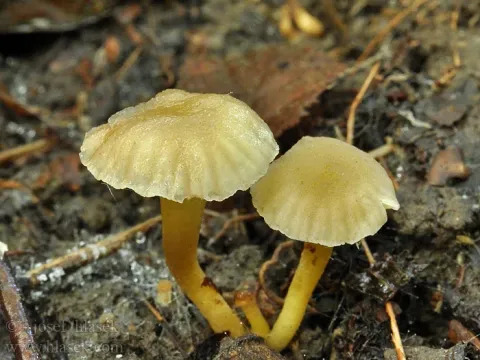
Camarophyllopsis micacea
Camarophyllopsis micacea
Camarophyllopsis micacea is a basidiomycete fungus that manifests through the appearance of small fruiting bodies. The primary external sign is the development of specific, often grayish or brownish gilled mushrooms on the soil surface or within dense turf.
What the section contains
Camarophyllopsis micacea
The appearance of these fruiting bodies is characterized by a mica-like or shiny coating, which gives the species its descriptive name. The fungal mycelium permeates the upper layers of the soil, forming a dense network that can suppress the root development of surrounding herbaceous plants.
Affected areas often appear as circular zones or chaotic clusters of mushrooms. In areas of intense mycelial growth, there is a visible discoloration of the vegetation, characterized by yellowing and gradual wilting due to disrupted water balance.
The turf structure in areas of active fungal development becomes loose, as the aggressive growth of the mycelium displaces grass roots. In dry weather, the fruiting bodies may dry out, leaving behind characteristic dark spots on the soil surface.
Disease diagnosis is often difficult because the fungus develops unnoticed in the soil layer for a long time. Detection usually occurs during the active fruiting phase when visible fungal structures emerge on the surface.
The causative agent is the fungus Camarophyllopsis micacea, belonging to the Hygrophoraceae family. It is a saprotrophic, though occasionally parasitic, fungus capable of thriving in areas with high organic matter content and specific moisture levels.
The biology of the fungus is closely linked to the decomposition of organic matter in the soil; however, its mycelium has the ability to colonize living plant roots. The pathogen’s life cycle involves intensive formation of basidiospores, which spread via air currents or water.
The life cycle includes a prolonged stage of vegetative growth in the soil, where the fungus accumulates biomass. During favorable periods, sexual structures—fruiting bodies—are formed, which are designed for the reproduction of the species.
The fungus exhibits high plasticity to environmental changes, allowing it to survive in the soil as mycelium for several seasons. It does not require a specific host plant, making it highly resistant to crop rotation measures.
The pathogen's genetic structure is adapted to live in various soil types, from sandy to clay loams. Its propagation efficiency depends directly on the availability of a suitable organic substrate required for the primary colonization of a site.
The primary condition for active development is high soil moisture and humidity in the boundary air layer. An ideal environment for growth is created during prolonged rains and moderate temperatures ranging from +15 to +22 degrees Celsius.
The fungus prefers areas with dense, poorly aerated soil where moisture stagnates. A lack of regular drainage contributes to the accumulation of organic matter, which is an ideal nutrient medium for active mycelial expansion.
Dense plantings and the presence of significant plant debris (uncollected clippings, fallen leaves) trigger disease outbreaks. Poor air circulation within the turf canopy creates a greenhouse effect that promotes spore germination.
Excessive application of nitrogen fertilizers, which stimulates rapid green growth, makes plants more vulnerable to fungal invasion. Weakened plant immunity facilitates the colonization of their root systems by the pathogen.
Spore dissemination occurs via insects, agricultural tools, and even footwear. The fungus spreads particularly quickly in shaded areas where the soil surface dries out very slowly.
The primary damage lies in the destruction of the aesthetic appeal of decorative lawns and landscapes. Intensive mycelial expansion leads to the death of turf in affected areas, leaving bare patches that are slow to recover.
The disruption of soil structure due to fungal activity leads to a loss of fertility and changes in pH balance. This creates unfavorable conditions for the continued growth of ornamental plants, which are outcompeted by the fungal mycelium.
When the root system is affected, the plants' ability to absorb nutrients and water is reduced, leading to degradation. In the long term, this may cause total lawn loss, requiring costly soil replacement.
The fungus competes with beneficial soil microflora, suppressing the development of symbiotic organisms. This disrupts the natural biological balance, making the site's ecosystem highly unstable and susceptible to other infections.
The economic danger also lies in the difficulty of localizing the infection focus. If measures are not taken in time, the mycelium quickly spreads to adjacent healthy areas, increasing the scale of damage and the costs of soil rehabilitation.
The main prevention method is improving soil aeration and drainage. Regular scarification and top-dressing the lawn with sand help reduce the moisture of the top layer, which is a critical factor in halting fungal development.
It is necessary to remove all plant debris in a timely manner, preventing its accumulation and decay. Thorough cleaning of the site deprives the fungus of the nutrient base required for successful reproduction and survival.
It is recommended to follow a proper irrigation schedule, avoiding evening watering, which creates moisture stagnation throughout the night. The optimal time for watering is early morning, allowing the soil surface to dry before night temperatures set in.
Upon detection of initial symptoms, broad-spectrum fungicides approved for lawn use should be applied. Treatment must be comprehensive, covering not only the infection focus but also the surrounding buffer zone.
- Perform regular raking to remove thatch;
- Apply potassium and phosphorus fertilizers in a balanced manner;
- Ensure high-quality site drainage;
- Perform timely soil aeration;
- Disinfect gardening tools after use.