
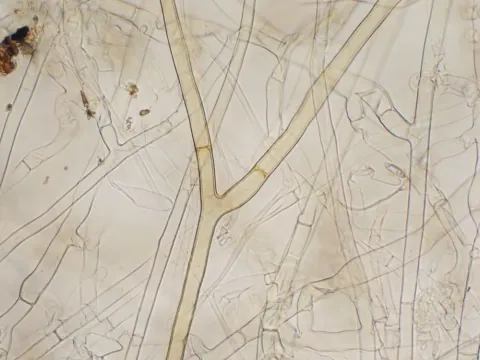
Rhizoctonia
Calocybe fallax
The disease is caused by the soil-dwelling fungus Rhizoctonia solani, which belongs to the group of imperfect fungi and has a very wide host range.
What the section contains
Rhizoctonia
The pathogen persists in the soil primarily as sclerotia, which are hard, melanized masses of hyphae capable of surviving for long periods in the environment.
The fungus typically functions as a saprotroph in the soil but rapidly transitions to a parasitic mode of life when coming into contact with plant roots or stems.
It is characterized by high environmental adaptability, allowing it to remain viable in various soil types and under fluctuating climatic conditions.
Infection is spread throughout fields via contaminated soil, infected seeds, planting materials, and agricultural machinery that carries soil particles.
A classic symptom of Rhizoctonia is the formation of reddish-brown or black lesions on roots, stems, and hypocotyls of affected seedlings.
On potato tubers, the fungus manifests as black scurf, which looks like small pieces of dark soil clinging to the skin of the tuber.
Seedlings often experience "damping-off," where the base of the stem collapses, leading to wilting, stunted growth, or complete death of the plant.
Under high humidity, a white, weblike mycelium (the basidial stage) may appear on the lower part of the stem, often called "white collar."
The root system of infected plants is typically poorly developed, brown, and necrotic, which prevents the plant from absorbing nutrients and water efficiently.
The pathogen thrives in moderate soil temperatures, typically ranging from 15 to 20 degrees Celsius, which is common during the early growing season.
High soil moisture is a critical factor, as it stimulates the germination of sclerotia and facilitates the movement of the fungus toward the host tissue.
Poorly drained, compacted, or heavy clay soils provide the necessary conditions for the fungus to persist and infect plant roots effectively.
Delayed germination of crops, often caused by cool and wet spring conditions, significantly increases the window of vulnerability to Rhizoctonia infection.
Short crop rotations that do not allow for the natural decline of the fungal population in the soil contribute to high levels of disease incidence.
Rhizoctonia causes significant economic losses by reducing plant stand density and causing early-season seedling death in many important crops.
The disease negatively impacts the aesthetic and market quality of root crops and tubers, often rendering them unfit for long-term storage.
By damaging the root system, the pathogen limits the plant's ability to cope with environmental stresses, such as drought or nutrient deficiencies.
Yield reduction is a direct consequence of the disease, as infected plants fail to reach their full physiological potential during the growing season.
The costs associated with replanting fields and applying prophylactic fungicides represent a substantial financial burden for commercial growers.
The most important control strategy is the use of healthy, disease-free seed and planting material to prevent the introduction of the pathogen.
Implementing long-term crop rotations with non-host crops is essential for reducing the inoculum density of the fungus in the soil over time.
Tillage practices that improve soil structure and promote the decomposition of plant residues can help decrease the survival of the fungus.
Chemical control usually involves seed or tuber treatment with systemic fungicides to protect the young plant during the early stages of establishment.
- Application of biological control agents like Trichoderma species.
- Optimizing planting depth and timing to ensure rapid emergence.
- Proper field drainage to prevent water accumulation.