

Description
Symptoms
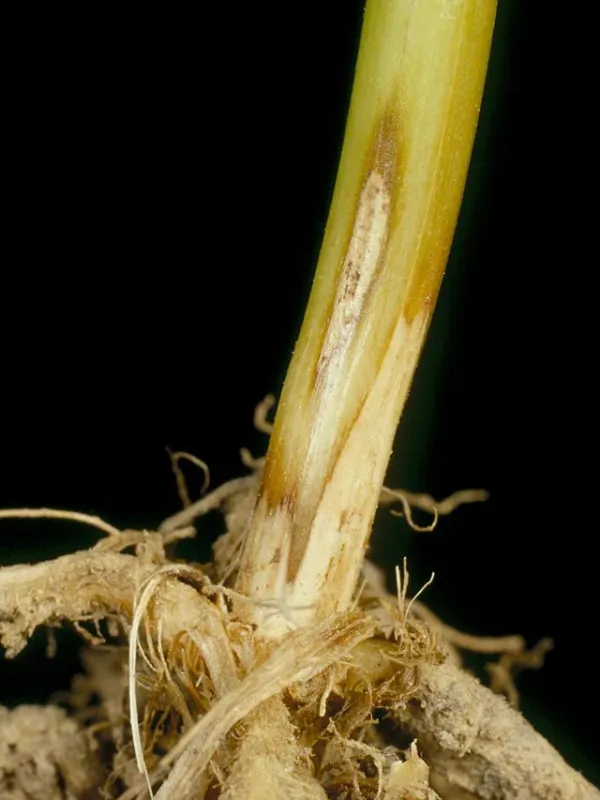
The characteristic symptom is the appearance of light brown or tan lesions on the stem base. These spots often develop a distinct dark brown margin, frequently referred to as "eyespot" or "sharp eyespot" lesions.
As the disease progresses, the infected stem tissues soften and become brittle, often leading to lodging. Lower leaves turn yellow and die prematurely, while the plant struggles to transport water and nutrients to the developing spike.
Under high humidity, a sparse greyish mycelium may be observed on the lesions. The damage to the root system is also significant, resulting in browning, decay, and a reduced root biomass that limits the plant's anchorage.
Infected plants often exhibit stunted growth and uneven stand development. In severe cases, the entire plant may die before maturity, resulting in empty patches within the cereal field.
At the grain filling stage, affected plants may produce white, sterile spikes known as "whiteheads." The grain that does form is typically shriveled, light, and low in starch, significantly reducing the final yield quality.
Pathogen
The causative agent of this disease is the fungus Rhizoctonia cerealis, which belongs to the basidiomycetes group. It is a soil-borne pathogen that persists in the soil and on crop residues for several years as mycelium or sclerotia.
Unlike some other Rhizoctonia species, this pathogen is well-adapted to cooler soil temperatures. It infects the roots and stem bases of cereal crops, causing necrotic lesions that disrupt the plant's vascular system.
The fungus spreads primarily through the vegetative growth of its hyphae in the soil. It lacks conidia, meaning its dispersal depends on physical movement in the soil or through infected plant material and equipment.
Rhizoctonia cerealis has a wide host range, primarily infecting wheat, barley, rye, and oats. Many common agricultural weeds can also serve as alternative hosts, maintaining the disease cycle in the field.
The fungus is highly competitive in soil environments. It thrives in the rhizosphere of cereal plants, where it consumes root exudates and eventually invades the tissue of the host plant, leading to stunted growth.
Conditions for development
The development of Rhizoctonia cerealis is favored by cool, moist conditions, particularly during the seedling stage in autumn and spring. Soil temperatures between 5 and 15 degrees Celsius are optimal for infection.
Poor soil structure, compaction, and acidic pH levels create ideal environments for the fungus to colonize roots. Soil that remains waterlogged for extended periods is particularly prone to severe disease outbreaks.
Short crop rotations, especially those involving continuous cereal monocropping, significantly increase the pathogen's inoculum density. The lack of host-free periods allows the fungus to thrive and multiply efficiently.
Late sowing of winter cereals often exposes the young seedlings to the most favorable infection conditions for the pathogen. Additionally, high nitrogen levels without adequate phosphorus and potassium can make plants more susceptible to damage.
Minimum tillage practices that leave significant amounts of crop residues on the soil surface provide a substrate for the fungus to survive. Infected seeds can also introduce the pathogen into new, clean fields.
Why it matters
The primary damage is a direct reduction in grain yield due to impaired nutrient uptake and moisture transport. Severely infected fields often experience widespread lodging, which significantly complicates the harvesting process.
Grain quality is negatively impacted, with infected plants producing shriveled and low-density kernels. This leads to lower market value and potential issues with grain processing and milling standards.
Root damage makes the crop more vulnerable to other stresses, such as drought or secondary infections by other fungi. Weakened plants are less capable of surviving harsh winter conditions, increasing the risk of stand loss.
Economic losses are compounded by the costs of applying fungicides and potential yield losses despite these measures. In some cases, the field may require re-seeding if the initial stand is too sparse.
Fields with high pathogen pressure often require a shift in agricultural strategy, such as abandoning susceptible crops for several years. This limits the farmer's flexibility in choosing high-value cereal varieties.
Protection
A well-planned crop rotation is the most effective long-term management strategy. Incorporating non-host crops, such as legumes or oilseeds, effectively reduces the level of Rhizoctonia inoculum in the soil.
Seed treatment with systemic fungicides is essential to provide early-season protection to seedlings. This helps the plants establish a healthy root system before the pathogen can successfully colonize the tissue.
Cultural practices, such as deep tillage to bury crop residues, can accelerate the decomposition of the fungal substrate. Ensuring proper soil drainage and optimizing soil pH through liming can also limit disease spread.
Balanced fertilization is key to promoting plant health. Adequate levels of phosphorus and potassium support root development and strengthen cell walls, making plants more resistant to fungal penetration.
In cases of severe infection, foliar fungicide applications during the tillering stage can help suppress the disease. However, early prevention through seed treatments and rotation remains the most reliable method of control.
Content graph
Connections · Rhizoctonia root rot
Most often together:
Marketplace
Products · 1
Community
Discussion
No discussions yet — be the first.