
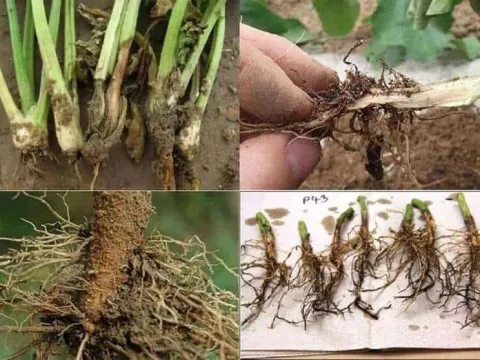
Rhizoctonia leaf spot
Rhizoctonia anceps
The disease is caused by the fungus Rhizoctonia anceps, a soil-borne basidiomycete. Unlike many other Rhizoctonia species, this pathogen exhibits a preference for infecting vegetative organs, including leaves and stems, rather than just roots.
What the section contains
Rhizoctonia leaf spot
This fungus persists in the soil and on crop debris as mycelium and sclerotia. It lacks conidia, meaning that its spread is primarily facilitated by the vegetative growth of hyphae across soil surfaces and direct plant-to-plant contact.
The morphology of Rhizoctonia anceps is characterized by hyphae branching at right angles, a diagnostic feature used in laboratory identification. It is a facultative parasite capable of surviving on organic matter for extended periods.
Its ability to remain latent in the soil makes it a persistent threat in agricultural systems. The fungus can thrive in various soil types, though it is most active in environments where moisture levels are consistently high.
Research indicates that the pathogen can infect a wide range of host plants, showing high adaptability. Understanding its life cycle is crucial for implementing effective crop management strategies in diverse agroecosystems.
The initial symptoms include the development of circular or irregular spots on leaves. These spots are typically light brown at the start, often showing a dark edge that contrasts with the surrounding healthy green tissue.
As the disease progresses, the center of the spots may turn pale or necrotic. In severe cases, these spots merge, leading to extensive leaf blight and premature leaf drop, which significantly weakens the plant's structural integrity.
Stem infections manifest as sunken, discolored lesions. These lesions can girdle the stem, disrupting the vascular system and preventing the efficient transport of water and nutrients to the upper parts of the plant.
Under conditions of high relative humidity, a fine, cobweb-like mycelial growth may appear on the surface of the lesions. This growth is a clear indicator of active fungal colonization and can lead to rapid spread in dense canopy conditions.
Early diagnosis is challenging, as symptoms may be subtle initially. However, close inspection of the foliage during humid periods usually reveals the presence of the pathogen’s characteristic growth pattern.
The growth and spread of Rhizoctonia anceps are heavily influenced by temperature and humidity. The pathogen is most active in moderate temperature ranges, typically between +15°C and +22°C, which are common in many growing seasons.
High humidity and prolonged leaf wetness are essential for the infection process. Dense plantings that limit airflow create a humid microclimate that allows the fungus to move easily between leaves and stems.
Fields with poor drainage or heavy soil textures are more prone to outbreaks, as these conditions maintain the soil moisture necessary for the fungus to persist and thrive throughout the growing season.
Excessive nitrogen fertilization can also promote succulent plant growth, which is more susceptible to fungal entry. Furthermore, failing to rotate crops allows the inoculum levels in the soil to build up over consecutive years.
Mechanical damage to leaves, often caused by heavy rain, hail, or agricultural machinery, provides easy entry points for the pathogen, significantly increasing the rate of infection across a field.
The primary impact of Rhizoctonia leaf spot is the reduction of the plant's photosynthetic capacity. By destroying leaf area, the fungus limits the plant's ability to produce energy, directly impacting crop yield and quality.
Stunted growth and premature senescence are common outcomes of infection. In commercial farming, this often translates to lower crop weight, reduced marketability, and diminished overall profit margins.
The weakening of the plants makes them more susceptible to secondary pathogens and pests. This complexity increases the difficulty of managing the crop and may require a broader range of interventions to save the harvest.
The persistence of the fungus in the soil ensures that the disease remains a long-term risk. Without proper management, the inoculum potential can increase, leading to severe outbreaks in subsequent planting cycles.
Economic losses are not limited to yield reduction alone; the increased expenditure on fungicides and additional labor required for monitoring and management contribute to higher production costs.
Effective management begins with strict crop rotation practices. Alternating host crops with non-host species is vital for reducing the pathogen load in the soil and preventing the build-up of sclerotia.
Improving field hygiene by removing or deeply incorporating crop residues after harvest is a key preventive measure. Ensuring proper plant spacing can improve aeration and reduce the humidity levels that the fungus favors.
Chemical control involves the use of systemic fungicides applied at the first sign of infection. These treatments are most effective when integrated into a broader disease management program that includes monitoring.
Selecting resistant cultivars or hybrids is the most sustainable approach to managing the disease. Breeding programs continue to focus on improving plant resilience against Rhizoctonia species.
- Treating seeds with appropriate fungicides to prevent early-stage infection.
- Managing irrigation to prevent excessive soil moisture or prolonged leaf wetness.
- Scouting fields regularly to detect symptoms at the earliest possible stage.
- Balancing mineral nutrition to improve overall plant health and vigor.