
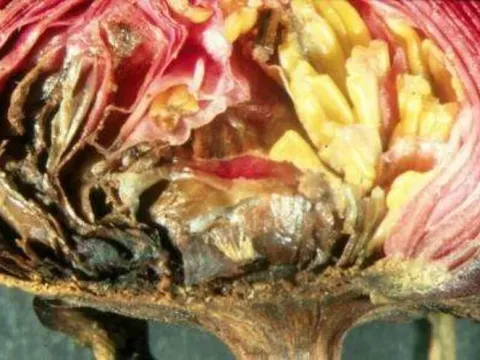
Peony botrytis blight
Botrytis paeoniae
The causal agent of this disease is the fungus Botrytis paeoniae. It is a highly specialized plant pathogen that primarily affects peonies, causing severe tissue decay during the growing season.
What the section contains
Peony botrytis blight
The fungus survives the winter as sclerotia, which are dark, hardened fungal structures residing in the soil or on infected plant debris left on the ground.
In early spring, when temperatures rise and moisture levels increase, these sclerotia germinate to produce spores (conidia). These spores are easily dispersed by wind, splashing rain, and garden tools, initiating the primary infection of young shoots.
The pathogen thrives in high-humidity environments, allowing it to transition between a parasitic phase on living host tissue and a saprophytic phase on decaying organic matter.
Because the fungus is so adept at surviving in the soil, it remains a persistent threat that can re-emerge every year if the plant environment is not carefully managed.
The first signs of infection appear in early spring as sudden wilting and browning of young shoots. A dark, sunken lesion often forms at the base of the stem, causing it to collapse and fall over.
Under humid conditions, a fuzzy, gray fungal mass becomes visible on the affected plant parts. This is the hallmark of the disease and indicates active spore production.
Flower buds are particularly susceptible to Botrytis. Infected buds turn brown or black, fail to open, and often shrivel. This phenomenon is frequently referred to as "bud blast" by gardeners.
Leaves may develop large, irregular brown or reddish-brown blotches. As the disease progresses, these spots can expand, causing the leaves to curl, dry out, and die prematurely.
Severe infections can extend to the crown and roots, leading to crown rot. This manifests as softened, decaying tissue near the soil line, eventually causing the entire peony clump to weaken and perish.
Botrytis blight is highly dependent on environmental moisture. Prolonged periods of rainfall, heavy dew, or high atmospheric humidity are the primary drivers of fungal outbreaks.
Cool to moderate temperatures, typically between 15°C and 20°C (59°F–68°F), create the optimal window for the pathogen to infect peony tissues.
Poor air circulation significantly exacerbates the issue. Plants that are crowded or located in damp, shaded areas stay wet longer, providing the fungus with the sustained moisture it needs to infect the host.
Excessive nitrogen fertilization can lead to soft, lush, and succulent growth. These tender tissues are much easier for the fungus to penetrate compared to hardened, well-balanced growth.
Sanitation plays a critical role in the disease cycle. The accumulation of fallen leaves and stems provides the fungus with a refuge to survive the winter and build up a high inoculum load for the next spring.
The most immediate harm caused by Botrytis is the destruction of flower buds, which renders the plant useless for ornamental purposes during the flowering season.
The disease causes systemic weakening of the peony plant. By reducing the leaf surface area and damaging the crown, the fungus prevents the plant from storing enough energy, leading to poor growth in subsequent years.
If left untreated, Botrytis can kill entire peony clumps, especially young or recently divided plants that have not yet established a strong root system.
The presence of the fungus creates a management burden, requiring the gardener to commit time and financial resources to fungicide applications and frequent sanitation.
Furthermore, an infected patch serves as a source of spores that can easily spread to other susceptible plants in the landscape, complicating garden management.
The first line of defense is proper site selection. Plant peonies in sunny locations with well-draining soil to prevent moisture accumulation and ensure good air movement around the foliage.
Practice rigorous garden hygiene. Immediately remove and destroy any plant parts showing symptoms of blight. Do not compost infected material; it should be bagged and discarded in the trash.
In the fall, after the first frost, cut all peony foliage down to the ground. Remove all stems and leaves from the garden site to eliminate the primary wintering sites for sclerotia.
Apply preventive fungicides during the spring when shoots are small (roughly 5-10 cm) and again when buds begin to form. Copper-based fungicides or systemic products containing active ingredients like tebuconazole can be effective.
Rotate the fungicides used to prevent the development of resistant strains of the fungus. Always ensure that the fungicide is applied thoroughly to both the upper and lower surfaces of the leaves and the surrounding soil.