
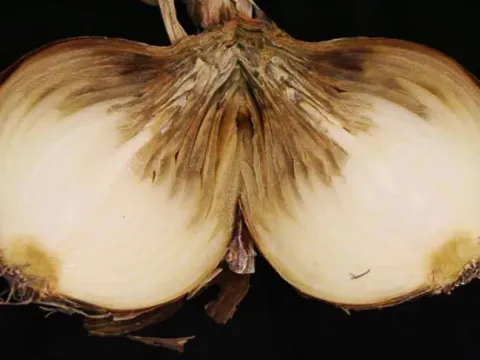
Botrytis neck rot of onion
Botryotinia squamosa
The causative agent of the disease is the fungus Botrytis allii (the teleomorph stage is Botryotinia squamosa). This pathogen is highly specialized and survives in soil or plant debris as sclerotia for several years.
What the section contains
Botrytis neck rot of onion
The fungus spreads primarily via conidia, which are wind-borne or dispersed by splashing rain. It targets onion tissues through natural openings or wounds, particularly in the neck area.
Infected bulb sets and contaminated soil serve as the primary sources of infection, allowing the fungus to establish itself at the beginning of the growth cycle.
The life cycle of the pathogen is closely tied to humidity levels, which trigger the production of spores and the subsequent colonization of host tissues.
The fungus is capable of persisting through adverse conditions by forming hard, black sclerotia that remain viable for extended periods in the field environment.
Symptoms typically begin to appear during late maturity or after the onions have been harvested and placed in storage, manifesting as softening of the neck tissues.
The affected neck tissue becomes water-soaked and eventually turns brown. If cut open, a grayish fungal mycelium and spore mass can often be observed between the scales.
Small black sclerotia often develop on the surface of the dry outer scales, eventually merging into solid crusts that serve as a diagnostic feature of the disease.
In the field, infected seedlings often wilt and collapse, a condition commonly referred to as damping-off, leading to significant stand loss.
Foliar symptoms may include small white spots surrounded by a green halo, which can lead to premature yellowing and dieback of the onion leaves.
The development of neck rot is favored by high relative humidity (above 85%) and moderate temperatures ranging from 15°C to 20°C during the maturation phase.
Poor ventilation in storage facilities leading to surface condensation is the primary driver for rapid spread of the disease among stored bulbs.
Mechanical damage caused by pests, such as onion maggots, or improper handling during harvest creates entry points that significantly increase infection rates.
Excessive nitrogen fertilization often leads to succulent, late-maturing tissues that are significantly more vulnerable to Botrytis infection.
Harvesting during wet weather prevents the onion necks from drying properly, leaving them vulnerable to the rapid colonization by fungal spores.
Neck rot is one of the most devastating post-harvest diseases, capable of causing total destruction of onion stocks if storage conditions are not strictly managed.
Economic impact is severe, as the disease is often latent, meaning bulbs may appear healthy at harvest but spoil rapidly once placed in storage.
Infected onions are unmarketable and pose a risk to the entire batch, as the fungus spreads readily from diseased to healthy neighboring bulbs.
Crop quality is severely compromised, and the presence of fungal toxins and unpleasant odors renders the bulbs completely unsuitable for food or processing.
The loss of plant density in the field due to seedling blight reduces potential yield even before the storage phase begins.
Crop rotation of at least 3 to 4 years is essential to break the infection cycle and reduce the population of sclerotia in the soil.
- Ensure proper drying and curing of bulbs after harvest to facilitate rapid sealing of the neck tissue.
- Maintain optimal storage conditions with temperatures near 0°C and relative humidity around 65-70%.
- Use disease-free planting material and resistant onion varieties whenever possible.
- Control insects and weeds throughout the growing season to minimize mechanical damage to the plants.
- Apply fungicides as a preventative measure according to the registered labels to suppress spore production.
It is critical to avoid harvesting during wet or humid weather to minimize the chances of moisture accumulation within the neck area.
Regular inspection of stored onions is necessary; any bulb showing signs of rot must be removed immediately to protect the remaining crop.