
Botrytis neck rot
Botrytis allii
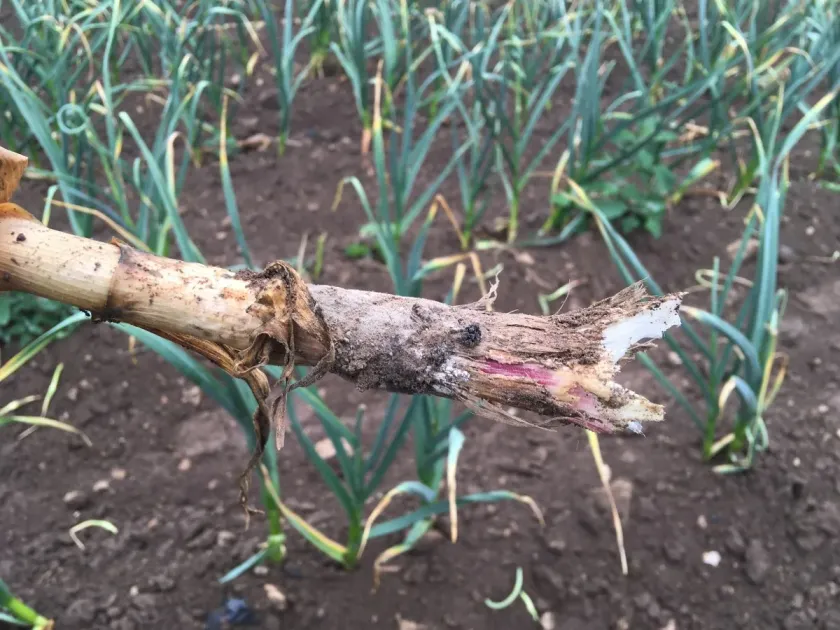
Description
Symptoms
The initial symptoms of neck rot are often visible near the end of the growing season, but the disease is most commonly detected during post-harvest storage. A softened, water-soaked area appears at the neck of the bulb, eventually developing into a sunken lesion.
As the pathogen progresses, the bulb tissue becomes soft and turns brownish, often emitting a distinct unpleasant odor. A thick, grey, fluffy fungal growth (mycelium) often covers the infected neck area, which represents the conidial stage of the fungus.
In the final stages of the infection, small, hard, black structures called sclerotia form on the neck and outer scales of the bulb. These structures are the primary survival mechanism for the pathogen in soil and debris.
When an infected bulb is cut open, the internal tissue appears necrotic, often resembling cooked or mushy flesh, with the decay spreading from the neck down towards the base of the bulb.
Severely affected bulbs eventually dehydrate, leading to complete desiccation and mummification, making them entirely unmarketable and unfit for culinary use.
Pathogen
The causative agent of this disease is the imperfect fungus Botrytis allii, which acts as a specialized parasite on various Allium species, including bulb onions, shallots, and leeks.
The life cycle of the pathogen is closely tied to soil, where it survives as sclerotia or mycelium. It can also be transmitted via infected planting material, such as sets or seeds (onion sets).
Infection typically occurs through the neck tissue if it remains insufficiently dry after harvest. Mechanical damage caused by pests or harvesting equipment can also provide entry points for the fungal spores.
The fungus secretes specialized enzymes that break down plant cell walls, allowing the infection to penetrate deep into the bulb tissue rapidly. The speed of colonization depends heavily on the storage conditions.
Botrytis allii is a highly host-specific pathogen, meaning it focuses its efforts on the Allium family, making crop rotation a vital management component.
Conditions for development
For the fungus to infect plant tissues effectively, it requires high humidity levels (typically above 75–80%) and the presence of free water (film of moisture) on the surface of the bulbs.
The optimal temperature range for the pathogen's development is between +15°C and +25°C. However, the fungus can maintain metabolic activity even at lower temperatures, which is why it persists in cold storage.
Harvesting during wet or rainy conditions is the most significant factor leading to outbreaks, as the neck tissue fails to dry properly, preventing the formation of protective scales.
Lack of proper curing after harvest is a critical oversight; if the necks are not thoroughly dried, they become an ideal entry point and breeding ground for the pathogen.
Poor ventilation within storage facilities and overcrowding of bulbs create microclimates that allow the fungus to spread rapidly from one infected bulb to adjacent healthy ones.
Why it matters
Botrytis neck rot is one of the most destructive diseases in onion storage, potentially causing losses of 50–70% of the entire crop if preventative measures are neglected.
The economic impact is primarily driven by the loss of produce quality, increased labor costs due to the need for manual sorting, and the inability to export or sell the contaminated stock.
Once established in a storage bin, the disease can spread exponentially, rendering entire batches of onions unsalable within a short period.
Field losses also occur when the fungus suppresses plant growth and causes premature wilting or death of the foliage, directly reducing the total yield weight.
Infected onions are generally considered inedible as the decay process produces fungal metabolites that can be toxic or cause severe gastric distress in humans.
Protection
The primary control strategy involves planting resistant cultivars and strictly adhering to crop rotation schedules, avoiding the cultivation of onions on the same ground for at least 3–4 years.
Harvesting should be timed for dry, sunny weather, followed by an intensive curing process at +25...+30°C for several days to ensure the neck is completely sealed and the outer scales are dry.
Fungicide applications during the growing season are recommended to reduce the initial spore load, especially if the weather forecast predicts prolonged wet spells.
Storage management must include maintaining a consistent temperature near 0...+1°C with vigorous air circulation to prevent condensation on the bulbs.
- Sanitation and removal of all crop debris from fields.
- Use of disease-free, high-quality seeds and sets.
- Balanced nitrogen fertilization to prevent overly succulent growth.
- Regular disinfection of storage crates and warehouse surfaces.
Discussion
No discussions yet — be the first.