
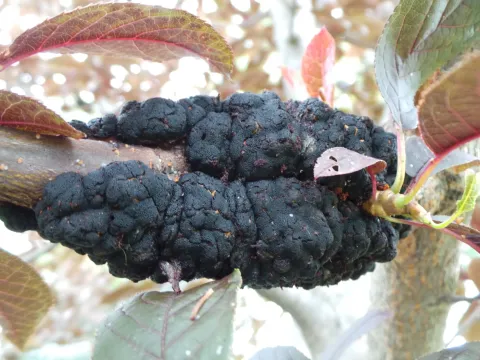
Black knot
Apiosporina morbosa
The causal agent of this disease is the fungus Apiosporina morbosa, which belongs to the Ascomycota division and specifically targets species of the Prunus genus.
What the section contains
Black knot
The fungus is a specialized pathogen that thrives within the vascular system of the branches, causing the plant to produce abnormal growth.
It completes its life cycle by producing spores during wet spring weather, which are then disseminated to healthy parts of the tree or adjacent trees.
Once the spores germinate on a susceptible shoot, the mycelium penetrates the bark and colonizes the cambium, leading to the development of woody galls.
This pathogen is highly persistent, capable of surviving for years in infected branches if not surgically removed from the orchard environment.
The primary symptom is the development of black, swollen, and crusty knots on branches, which increase in size as the infection progresses.
Initially, these growths might be greenish or light brown and soft, but they eventually turn black, hard, and brittle during the dormant season.
The disease frequently affects common cherry (Prunus cerasus) and sour cherry varieties, often leading to severe branch deformation.
In spring, the surface of the knots may become covered with a velvet-like olive-green coating, which represents the fungal spore-producing structures.
As the galls expand, they often wrap around the branch, effectively girdling it and cutting off the flow of water and nutrients to the distal parts.
Cool, wet spring weather provides the optimal environment for the germination of fungal spores and the subsequent infection of young green shoots.
Poor orchard sanitation, characterized by the presence of old infected branches, provides a constant source of inoculum for new infections.
Trees with dense, unpruned canopies are more prone to infection because they stay damp for longer periods after rainfall or morning dew.
The fungus is most successful in spreading when temperatures are moderate and rainfall is frequent, which facilitates the splash dispersal of spores.
Weakened trees or those suffering from drought stress or mechanical damage to the bark are significantly more susceptible to successful pathogen colonization.
The most significant harm is the decline and eventual death of branches, which leads to a substantial loss of the tree's fruit-bearing canopy.
Severe infections can lead to the death of the entire tree if the fungus spreads to the main trunk or scaffold branches, causing a systemic decline.
The tree's health is severely compromised as it diverts energy to isolate the infection, leaving it vulnerable to other pests and opportunistic diseases.
Fruit production is negatively impacted both in quantity and quality, leading to significant economic losses for commercial fruit growers.
The physical disfigurement of the tree makes it less productive and eventually unusable, necessitating total removal and replanting of the specimen.
Pruning is the most critical management tool; all knots must be removed at least 10–15 cm below the visible growth to ensure the fungus is eradicated.
All pruned material containing knots must be destroyed by burning or removed from the site to prevent further spore dispersal in the spring.
Applying dormant season fungicide sprays, particularly those containing copper, can help reduce the spore load and prevent new infections.
Maintaining a healthy, well-pruned tree canopy improves airflow and allows for faster drying of shoots, reducing the risk of fungal colonization.
- Disinfect pruning tools with alcohol or a bleach solution between cuts.
- Conduct regular orchard inspections during the early spring.
- Encourage proper tree vigor through balanced fertilization and watering.