
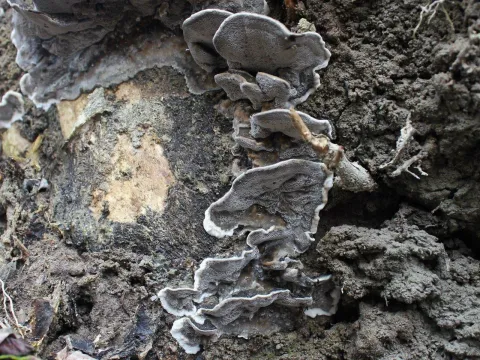
Bjerkandera adusta
Bjerkandera adusta
Bjerkandera adusta is a wood-decaying basidiomycete fungus belonging to the Meruliaceae family. It is recognized as a primary agent of white rot, targeting both hardwood and occasionally coniferous trees.
What the section contains
Bjerkandera adusta
This fungus primarily functions as a saprotroph, decomposing dead wood, but it can behave as a facultative parasite, attacking stressed or weakened living trees.
Biologically, the fungus is highly efficient at breaking down lignin and cellulose through a complex enzyme system, causing the wood to become fibrous and soft.
The fruiting bodies are typically annual, appearing as resupinate or shelf-like clusters on the bark. They are characterized by a greyish-brown cap and a distinct, dark sooty-black pore surface.
Spores are disseminated by wind, allowing the pathogen to colonize new sites efficiently, particularly when landing on fresh wounds or damaged bark surfaces.
The most visible sign of infection is the emergence of fungal fruiting bodies on the trunk or stumps. These clusters often appear in tiers and can merge together as they mature.
Infected wood undergoes significant structural changes, shifting to a light, bleached appearance often called white rot, which lacks the original mechanical strength of the wood.
Distinctive black zone lines may appear within the decaying wood, separating different stages or colonies of the mycelium, which is a hallmark of white-rot decay patterns.
As the rot progresses, the core of the tree becomes hollow, which may lead to the formation of cavities or sudden structural failure, such as snapped branches or trunks during high winds.
Because the disease primarily affects internal tissues, the foliage may remain visually healthy until the structural integrity of the tree is critically compromised.
Development of Bjerkandera adusta is heavily dictated by wood moisture levels. The fungus thrives in areas where moisture accumulates due to structural defects or environmental factors.
High humidity and poor air circulation in dense forest stands or poorly managed orchards provide optimal conditions for spore germination and mycelial spread.
Mechanical injuries, such as frost cracks, pruning wounds, or damage caused by maintenance equipment, serve as critical entry points for the fungal spores.
The pathogen is most active during warm and wet periods, though the mycelium can persist within the wood during winter, remaining ready to resume activity during warmer months.
Excessive accumulation of woody debris and stumps in the vicinity of living trees significantly increases the risk of infection by providing a permanent reservoir for the fungus.
The primary damage caused by this fungus is the rapid structural degradation of tree trunks, which limits the lifespan of affected trees and reduces the value of timber.
In landscape and urban environments, infested trees pose a significant safety risk, as their weakened internal structure makes them prone to unexpected collapse.
Orchards suffering from this decay experience reduced fruit production and eventual loss of the trees, necessitating costly removal and replanting efforts.
The fungus promotes further decline by weakening the tree's natural defenses, making it increasingly susceptible to secondary pest attacks and other pathogenic infections.
Financial impact is notable in forestry, where white rot renders wood unsuitable for structural lumber or high-quality carpentry, leading to significant economic losses.
The first line of defense is ensuring tree vigor through proper horticultural practices, as healthy trees possess better natural defense mechanisms against fungal colonization.
All pruning should be performed using sharp, sterilized tools, and fresh wounds should be immediately protected with appropriate wound sealants or fungicidal pastes.
Sanitation is critical: all infected wood, including stumps and branches, should be promptly removed and disposed of through burning to reduce the local inoculum density.
Regular inspection of valuable trees for fruiting bodies allows for the identification of decay at a stage where localized treatment or support might still be possible.
- Prompt removal of diseased trees and stumps.
- Disinfection of pruning tools between uses.
- Mechanical protection of bark from equipment damage.